
 Posted by
 In the quiet of Yale University’s Beinecke Rare Book & Manuscript Library lies one of the greatest mysteries in human history: the Voynich Manuscript. This medieval codex, dating back to the 15th century, has challenged the brightest minds of linguists, cryptographers and historians for over six centuries. Written in an unknown language and script, its 240 pages of parchment are densely covered with unintelligible characters, arranged with a regularity that suggests a structured language, but which no one has ever been able to decipher.
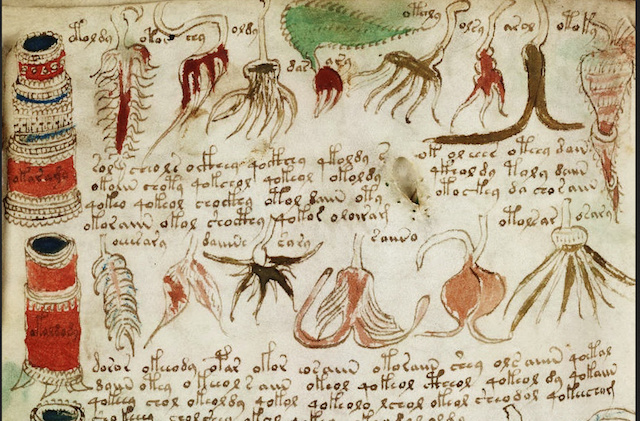
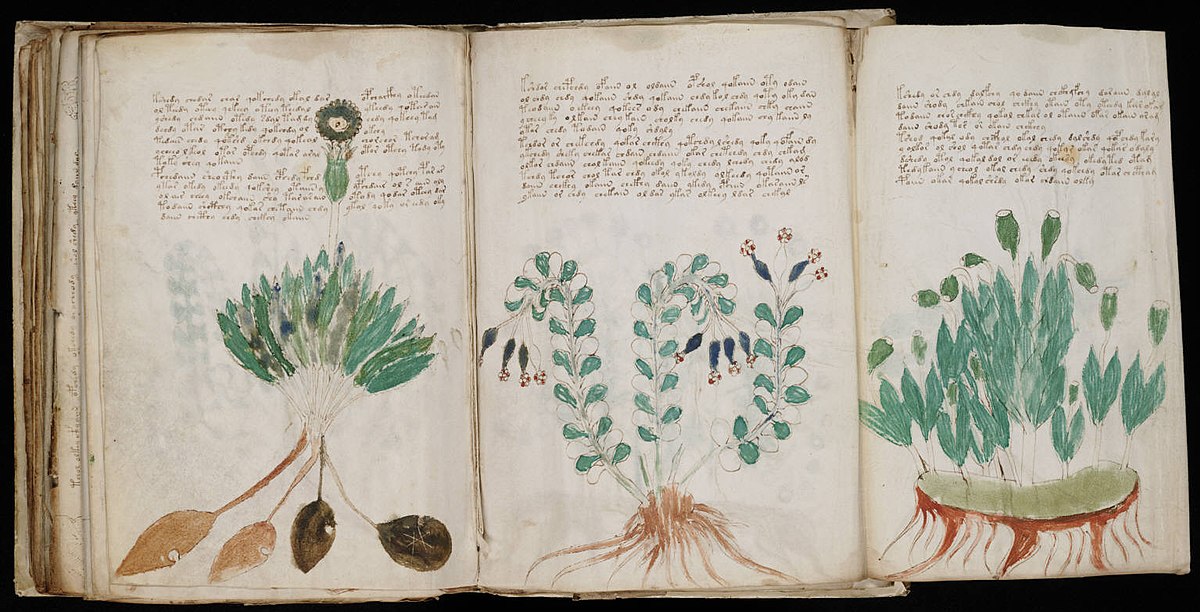
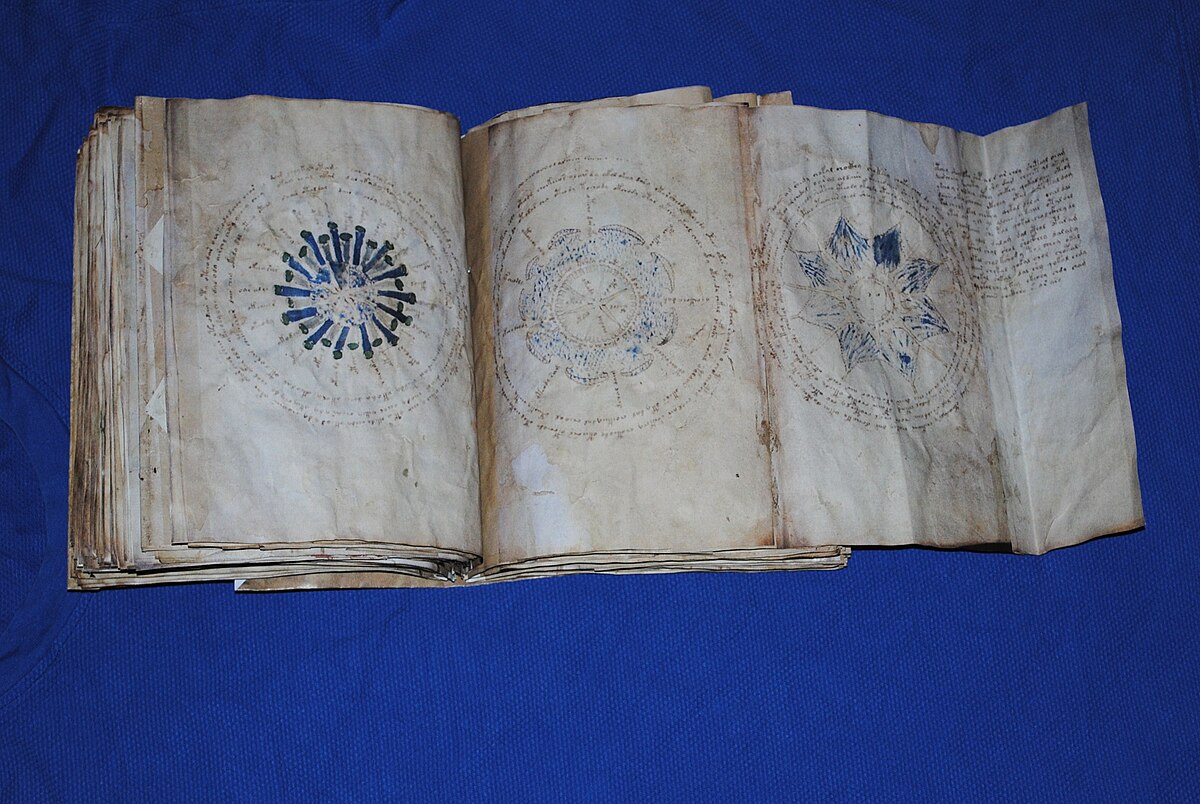
Adding to the mystery are the bizarre illustrations accompanying the text: plants unknown to modern botany, celestial diagrams of impossible constellations, naked female figures immersed in strange hydraulic devices. A bestiary of images that seem to come from a dream, or perhaps from ancient and lost knowledge.
Since its discovery in 1912 by bookseller Wilfrid Voynich, this manuscript has generated theories ranging from Renaissance alchemy to esoteric linguistics, from medieval medicine to the possibility of an elaborate historical forgery. Every year, new scholars attempt to decipher it, armed with the most advanced technology, but the Voynich still holds its secret, challenging our understanding and fuelling endless speculation.
The history of the manuscript
Many hypotheses have been put forward about this mysterious manuscript, but let’s start with the facts.
This book was purchased by a Polish book dealer, Wilfrid Voynich, from a Jesuit college in Villa Mondragione in 1912. It is Wilfrid who gave the manuscript its name.
Inside the book was a letter written by Johannes Marcus Marci, rector of the University of Prague and royal physician to Rudolf II of Bohemia. The date was 1665, and the letter indicated that Johannes was sending the book to a friend in Rome to be deciphered.
After the discovery, Voynich spent years trying to decipher the manuscript, involving scholars and cryptographers without success. In 1930, upon his death, the volume passed to his wife Ethel Voynich, author of the famous novel The Cardinal’s Daughter, who in turn left it to her friend Anne Nill. In 1961, the manuscript was sold to antiquarian Hans P. Kraus, who, unable to find a buyer willing to pay the asking price, finally donated it to the Beinecke Rare Book & Manuscript Library at Yale University in 1969, where it is still kept today under the code MS 408. Initially, the book was thought to date from the 16th century, but in 2011, carbon-14 dating revealed that it had been written between 1404 and 1438.
Many have tried (and are still trying) to decipher it, but no one has yet succeeded. Many hypotheses have been put forward:
- that it was a forgery.
- that it was Latin in disguise.
- that it had been written with special tables for encrypting documents, already known in the past.
Let’s look at them in detail
The theories
One of the most widely accepted theories is that it is a medieval herbarium, perhaps a compendium of botanical and pharmacological knowledge encrypted to protect professional secrets. The intricate illustrations of unknown plants, some of which seem to combine characteristics of different species, could represent an attempt to catalogue medicinal remedies known only to a few initiates at the time.
Other scholars have proposed that the text is written in an artificial language, perhaps created for esoteric or philosophical purposes. Secret writing systems and constructed languages were popular during the Renaissance, as demonstrated by the studies of figures such as John Dee and Athanasius Kircher. Some speculate that the manuscript is a product of this tradition, perhaps an alchemical treatise or an encrypted text containing forbidden knowledge.
There is no shortage of more daring theories. Some researchers have suggested that the Voynich is the work of a Renaissance forger, perhaps created to swindle a wealthy collector such as Rudolf II of Habsburg, who was known for his passion for the occult.
Others have proposed decidedly more imaginative explanations: some see the manuscript as an extraterrestrial message, others consider it a text in an unknown Asian language transliterated into Western characters, and there are even those who believe it to be the work of a time traveller.
Among the most recent hypotheses, some linguistic analyses have suggested that the text could be an archaic form of a Romance or Semitic language, while statistical studies have found patterns reminiscent of those of natural languages, although no deciphering has been universally accepted. Although researcher Stephen Bax has attempted to identify individual terms by comparing the illustrations with real plants, he has obtained partial but inconclusive results.
Modern decryption techniques used during and after World War II by the US Navy have also been applied, but the manuscript was the only text that failed to produce any results.
The linguistic structure of the Voynich manuscript
Among the researchers who have demonstrated that the Voynich Manuscript conceals a coherent linguistic structure, the work of Brazilian physicist Diego Raphael Amancio (University of São Paulo) and the team led by Marcelo Montemurro (University of Manchester) stands out. In 2013, both groups published groundbreaking studies in PLOS ONE which, using quantitative methods and advanced statistical models, provided decisive evidence against the hypothesis that the text was a simple set of random symbols.
Amancio and his team compared the Voynich manuscript with over 200 works in different languages (from Latin to Arabic, Chinese to Esperanto), discovering that it showed patterns of correlation between words identical to those of real languages, with less than a 10% probability that it was “pure nonsense”. Using machine learning algorithms, they also identified a semantic hierarchy: words were grouped thematically around the illustrations (botanical, astronomical, etc.), as is the case in medieval scientific texts.
At the same time, Montemurro applied models borrowed from theoretical physics, revealing that the Voynich manuscript obeys precise statistical laws, including Zipf’s distribution (typical of natural languages) and a hierarchical structure that distinguishes “content” words from “structural” words. His study also highlighted semantic patterns that are impossible to replicate artificially, such as the correlation between specific terms and thematic sections.
Although this research has buried the idea of a meaningless forgery, fundamental questions remain: is the text a forgotten natural language, an encrypted code or a constructed language? As the researchers themselves point out, without a “Rosetta Stone” linking the Voynich to a known language, complete deciphering remains elusive.
The Voynich manuscript: a possible solution
In 2014, Stephen Bax, professor of linguistics at the University of Bedfordshire, proposed a provisional encoding of some words belonging to certain plants and the constellation Taurus and the translation of 14 of the signs of the mysterious alphabet. Bax started with images of subjects known to us to derive some reliable names and, after his research, put forward the hypothesis that it is neither a forgery nor an encrypted alphabet but simply an extinct language or dialect. According to the professor, it was written in the Caucasus region.
Modern techniques in search of a solution
In recent years, the advent of artificial intelligence has opened up new fronts in the battle to decipher the Voynich Manuscript. While linguists and cryptographers have tackled the puzzle with traditional methods for centuries, today powerful machine learning algorithms are sifting through the text in search of patterns that have escaped the human eye. In 2018, a team from the University of Alberta led by Professor Reg Kondrak applied computational linguistics techniques, suggesting that the text could be coded Hebrew, with words stripped of vowels and rearranged alphabetically. However, medieval manuscript experts who studied the results seem sceptical.
In 2019, researchers at the University of Bristol confirmed that it has characteristics typical of natural languages rather than random text. Biologist Gerard Cheshire claimed to have deciphered the manuscript in just two weeks, publishing his translation in 2023. However, bibliographer and palaeographer Lisa Fagin Davis stated that this was not the solution.
The University of Bristol subsequently removed Cheshire’s translation from its website, making it clear that it was not affiliated with the university. Algorithms have identified recurring patterns in the distribution of “words” that closely resemble those of medieval Romance languages, although no coherent vocabulary has emerged from the analysis.
Particularly promising is the approach of neural network systems, which, by mimicking the functioning of the human brain, can recognise complex patterns in the arrangement of characters. Some of these models have even attempted to “write” new text in Voynichese, producing sequences that at first glance appear authentic but, like the original, remain devoid of recognisable meaning.
Despite increasingly sophisticated tools, the manuscript remains a mystery. New technologies and AI can identify structures and probabilities, but without a “Rosetta Stone”, a parallel text in a known language, even the most advanced algorithms are groping in the dark. Perhaps the solution will require a combination of artificial intelligence and human intuition, a marriage of modern technology and ancient scholarship that can finally untangle a knot that has persisted for six centuries.
A puzzle still incomplete
After centuries of study, the Voynich Manuscript remains one of the most enduring intellectual challenges in human history. Each generation of researchers has come up against the same wall of incomprehension that stopped the first scholars in the 17th century. Perhaps it is this very difficulty that makes the manuscript so fascinating.
In an age when science seems to be able to explain almost everything, the Voynich reminds us that there are still enigmas capable of resisting the advance of knowledge.
Would you like to try to decipher the manuscript? You can view it online here.
This book is written in god language… In Hindi “Dev Lipi” that is mean this language use by Indian god and goddess..