 Posted by
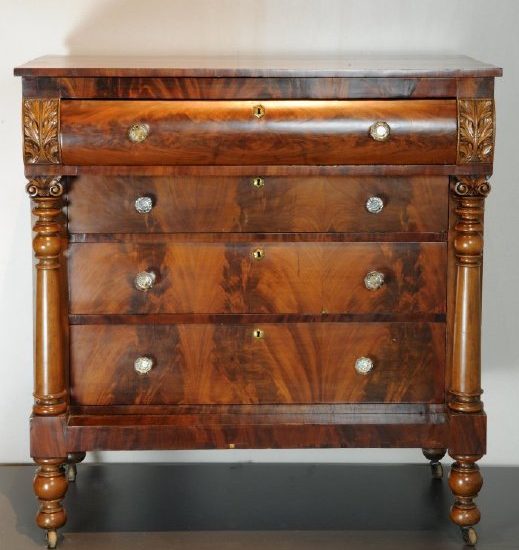
 There are many stories of cursed objects, but one that sends shivers down your spine is that of Jacob Cooley’s cursed chest.
In 19th-century Kentucky, an innocent-looking chest hid a dark secret. Created at the behest of the cruel slave owner Jacob Cooley, this seemingly ordinary object became the protagonist of a story of death and mystery that spanned generations.
Legends say that anyone who put their clothes in it was doomed to meet a tragic end. Unexplained victims, sinister events, and a curse that seemed impossible to stop.
Today, the chest rests in a museum, far from prying eyes. But some details raise a question: is its story really over?
Jacob Cooley’s cursed chest
Jacob Cooley was a ruthless man. A wealthy landowner in Kentucky in the 1800s, he ruled his plantation with brutality, treating his slaves as objects rather than human beings. When his wife became pregnant, Cooley ordered Hosea, a skilled slave carpenter, to build a chest for the unborn child. Hosea worked day and night, carefully carving every detail of the piece, perhaps hoping that his skill would earn him better treatment.
But when Cooley saw the finished chest, something triggered his rage. Perhaps it was an imperceptible flaw, or perhaps it was just his sadistic desire to humiliate the slave once again. In a fit of violence, he beat him savagely, leaving him to bleed to death in the dust. That night, while Cooley slept contentedly, the other slaves gathered in secret. Among them was an old man who knew the ancient African rituals, a witch doctor. And it was he who uttered the words that would bind the chest forever to a terrible curse.
The curse
In the thick darkness of the night, while the plantation lay in an unnatural silence, the slaves gathered in the witch doctor’s hut. The old man, his eyes clouded with cataracts but his mind sharp as a razor, prepared the ancient ritual with meticulous movements.
From the leather bag tied around his neck, he took out dried bones, black roots, and the most sacred ingredient, a vial of dried owl’s blood, collected during the last new moon.
While the other slaves murmured prayers in forgotten languages, the witch doctor cautiously opened the third drawer of the chest. With a gnarled finger, he traced ancestral symbols on the wooden bottom, then sprinkled the contents of the vial in a perfect spiral.
“He who sows the wind shall reap the whirlwind,” he hissed, as the reddish powder seemed to pulsate in the moonlight. “Every garment that touches this wood will bring mourning to the master’s house. Until seven generations have mourned their dead.”
A sudden wind shook the hut as the slaves, one after another, spat into the drawer. The last to do so was Hosea’s young son, twelve years old, who added a lock of his own hair soaked with tears shed for his father.
At sunrise, the chest was back in its place in the mistress’s room, apparently identical to before. But anyone looking closely at the third drawer would have noticed that the knots in the wood, under the right light, now formed the distorted outline of an owl.
The first victim
Little William Cooley was born on a cold December morning. The mistress, exhausted from labor, smiled when the midwife placed the bundle wrapped in fine linen in her arms. But that smile froze when she realized that the baby was not crying.
The newborn was barely breathing, his eyelids tightly closed as if refusing to see the world he was destined for. Jacob Cooley, instead of worrying, sneered: “I don’t need a weak son. He’ll get stronger.” And he ordered that he be dressed in the precious clothes already laid out in the cursed chest.
The nurse, a slave named Esther, tried to object. She had seen the middle drawer of the chest open by itself the night before and heard a sound that sounded too much like the rustling of feathers. But a whip silenced her.
When she slipped the silk shirt onto little William, the fabric was instantly stained with cold sweat.
At three o’clock the following morning, the baby was already dead.
On the lifeless chest of the little boy, just above his heart, there was a strange reddish mark in the shape of a claw. The same mark that, years later, would be found on many of the other unfortunate souls who crossed paths with the chest.
The curse spreads
The death of little William was only the beginning.
Instead of being destroyed, the chest became a macabre heirloom, passed down from generation to generation as a dark family relic. And with it, the curse traveled.
John, William’s younger brother, became the new heir to the Cooley estate and the chest. An arrogant and violent man like his father, he did not believe in “slave stories.” But when his personal servant, a mild-mannered man who silently endured his abuse, stabbed him to death in his sleep, many began to suspect something was amiss.
The shirt John was wearing that night, the same one he was found lifeless in, had been placed in the chest just the day before.
And the curse did not stop there.
Melinda, Jacob Cooley’s youngest daughter, received the chest as a wedding gift. Her marriage to a charming Irish adventurer turned into a nightmare: he abandoned her, leaving her alone to raise their children in poverty. When Melinda died, worn out by fatigue and despair, the chest passed to her adopted daughter, Evelyn.
Evelyn used it to store precious clothes, including her daughter Arabella’s wedding dress. Shortly after Arabella’s marriage, her husband died for no apparent reason. Their child followed the same fate.
One after another, the victims piled up. Every time a garment was placed in the chest, its owner met a tragic end: unexplained accidents, sudden illnesses, suicides.
The family began to suspect something, but it was too late. The curse was now ingrained in their blood.
The ritual of liberation
Virginia Cary Hudson, the last descendant to own the chest, had always considered the stories about the curse to be silly superstitions. But when her eldest son also died after his clothes had been stored in the chest, she decided to take action.
She did not turn to a priest or an exorcist, but to an unusual ally: Annie, an elderly black woman who worked as an herbalist in the nearby village. Annie listened to the story with an inscrutable expression, then nodded.
“That’s not superstition,” she said finally. “It’s ancient knowledge. And to break it, you’ll need even older knowledge.”
The ritual she proposed was precise and disturbing:
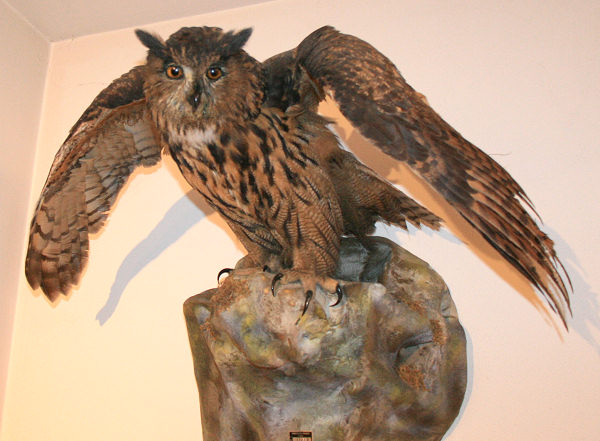
- A dead owl, given without being asked
- Willow leaves boiled from dawn to dusk under the gaze of the bird
- A jug filled with the liquid obtained, buried under a flowering bush with the handle facing east
For weeks, Virginia waited in vain for the gift of the owl, until one day her younger son came home with a stuffed specimen given to him by a friend. It was a sign that fate was in motion.
On the day of the summer solstice, Virginia and Annie staged a scene that seemed straight out of a Gothic tale: the large black cauldron boiling on the fire, the stuffed owl seeming to watch with glassy eyes, the willow leaves releasing a bitter aroma into the sultry air.
At sunset, they buried the jug under a flowering lilac bush. Annie warned her: “If the ritual works, one of us will die before autumn. She will be the last victim.”
On September 5, Annie did not show up at the market. They found her in her bed, peaceful, with a slight smile on her lips.
From that day on, no new tragedy struck the Hudson family. But when Virginia donated the chest to the museum, someone noticed that she had placed a sealed envelope in the cursed drawer. And even today, the custodians claim that on full moon nights, a sound like the rustling of wings can be heard coming from the piece of furniture…
The conjure chest today
In 1976, Virginia formally donated the chest to the Kentucky History Museum. Today, the chest rests in the museum’s climate-controlled vault, catalogued as “Federal-style walnut cabinet, circa 1820-1830.” But the precautions surrounding it go far beyond normal preservation:
- Top drawer sealed with metal tape and red wax
- Motion sensors pointed at it 24 hours a day
- Guard shifts that no employee wants to do alone
The access log shows a curious detail: every September 5 (the anniversary of Annie’s death), a technician from the University of Louisville performs a “routine thermographic check.” The infrared images, never made public, reportedly show a curious source of cold concentrated in the third drawer.
The current curator, Dr. Samuel Greeley, declines to comment on the “folklore surrounding the article,” but admits, “Some artifacts have complex histories. This one in particular… well, let’s just say we prefer to study it from a distance.”
Perhaps the curse really did end with Annie. Or perhaps it is just waiting for someone to open it again…