 Posted by
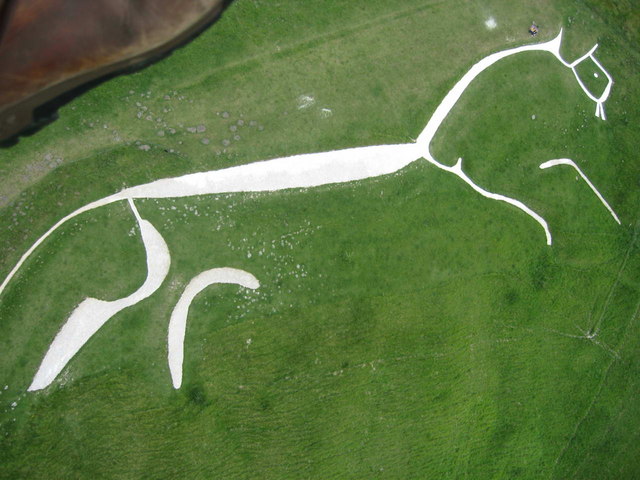
 Photo: Aerial view of the Uffington White Horse from a paramotor by Dave Price, licensed under CC BY 2.0.
Imagine walking through the rolling hills of Oxfordshire when suddenly, beneath you, the landscape transforms into an ancient work of art. A 110-meter-long horse, with sinuous and mysterious lines, emerges from the ground like a ghost from the past. It is the Uffington White Horse, one of Europe’s most enigmatic geoglyphs, carved into the hillside over 3,000 years ago and still shrouded in mystery today.
Unlike the more recent famous chalk horses scattered across England, this is not a simple folk design: it is a relic of the Iron Age, a symbol that could be linked to Celtic cults, astronomical rituals or even Arthurian legends. Yet, despite the theories, no one knows for sure who created it or why.
Its beauty? It is only fully visible from above, like a secret message left by the ancient inhabitants of these lands. But what makes it truly special is how it has survived the centuries: thanks to a tradition called “scouring,” where generations of locals have taken care of it, cleaning it and redrawing it, as if in an endless ritual.
Today, this silent horse continues to dominate the valley, defying time and inviting curious travelers to discover its secrets. Ready to follow it on a journey through history and legend?
A message carved in time
Who first drew those white lines on the hill? The White Horse of Uffington left no signatures or written accounts, but archaeologists have tried to decipher its origin through clues hidden in the landscape and history.
The most reliable dating places its creation in the British Iron Age, between 1000 and 500 BC, although some scholars do not rule out an even earlier origin, perhaps linked to Bronze Age communities. The technique used is simple but effective: the artists of the past dug into the ground until they reached the underlying layer of chalk, creating a striking contrast with the surrounding grass.
But why a horse? And why in such a peculiar style, with an elongated body and spindly legs that make it look almost like a greyhound? There are many theories: it could be a tribal symbol linked to a Celtic population, perhaps the Atrebates, who ruled the region before the arrival of the Romans. Others link it to a sun cult, as its shape seems to reflect astronomical movements.
An intriguing clue comes from coins of the period: some minted by local tribes depict horses stylized in a manner very similar to the geoglyph. Perhaps, then, this horse was more than just a drawing. Perhaps it was a mark of power, a sacred icon, or even a celestial map.
But the truth, for now, remains buried under layers of time and grass, waiting to be revealed.
A sacred sign in the earth
The White Horse of Uffington is not just an ancient work of art, but a symbol laden with lost meanings, rooted in the spirituality of Celtic and pre-Celtic peoples. Its sinuous and abstract shape evokes a connection with the divine, perhaps associated with Epona, the horse goddess worshipped in Gaul and Britain, protector of knights and travelers.
Some scholars speculate that the geoglyph was part of a ritual landscape, linked to ceremonies related to fertility, war, or seasonal cycles. Its dominant position over the valley suggests that it may have been a landmark visible from afar, perhaps a gathering place for local communities during sacred festivals.
The legend, however, goes beyond history. In medieval tradition, the horse was associated with King Arthur, with some stories identifying it as the mythical ruler’s steed or even as a petrified magical creature. The nearby Dragon Hill, a hill with a strangely flat top, is said to be the place where St. George slew the dragon, and it is said that the creature’s blood made the land barren, which is still grassless today.
Whether it is an open-air temple, a sign of power, or a page from a forgotten story, the White Horse continues to defy interpretation, maintaining its aura of mystery intact. Every line traced in the chalk seems to whisper an ancient truth, just waiting to be heard.
The miracle of its survival
What makes the White Horse of Uffington extraordinary is not only its age, but the fact that it has survived for thousands of years. Unlike many monuments protected by walls or display cases, this geoglyph has survived thanks to a living tradition that unites past and present: “scouring,” the ritual cleaning of the chalk.
For centuries, local communities have gathered every seven years (more recently on an annual basis) to clean the grassy furrows that outline the figure, bringing the brilliant whiteness of the chalk beneath back to light. This practice, documented since the 17th century but probably much older, transforms preservation into a collective, almost ceremonial act.
Today, the site is protected by the National Trust, which coordinates maintenance work using modern tools, but respecting the original spirit. Challenges abound: natural erosion, plant roots, and even the footsteps of too many visitors threaten to gradually erase the contours. For this reason, mandatory paths have been created to prevent direct trampling on the figure, while geophysical studies monitor its state of health.
The White Horse reminds us that monuments do not live in a showcase: some, like him, need hands to caress them and eyes to watch over them, generation after generation. It is an ancient pact between man and landscape, where care is not only technical but also a shared legacy.
Visit the White Horse
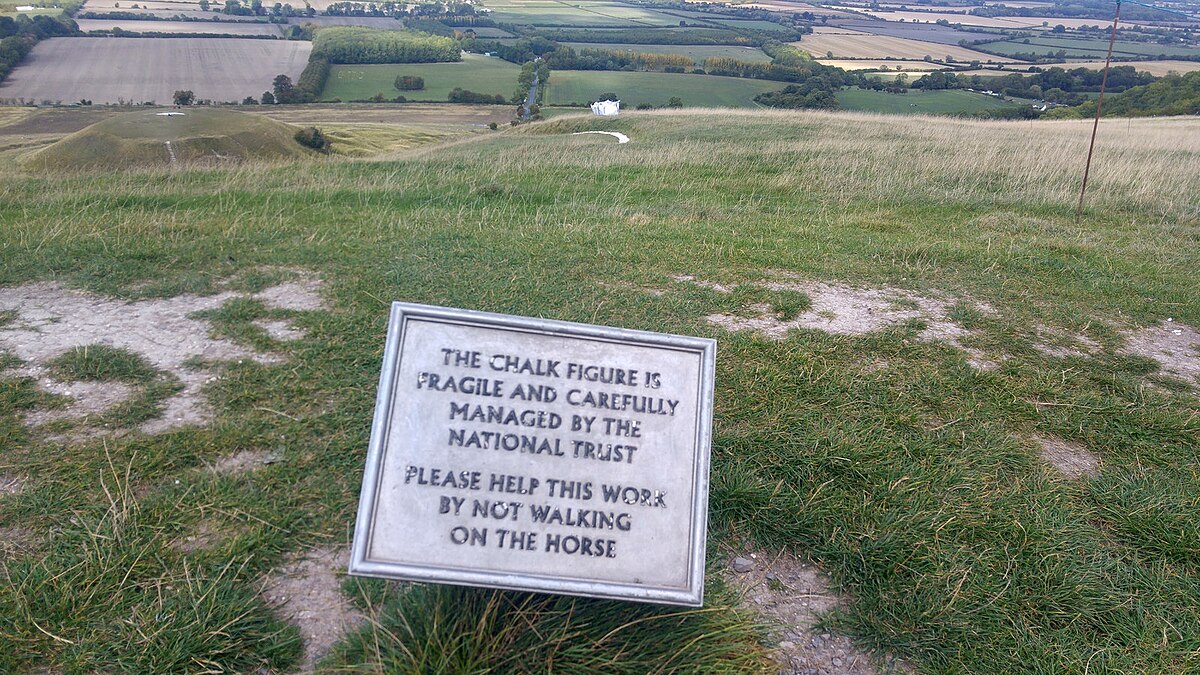
Today, the White Horse of Uffington attracts visitors from all over the world, offering an experience that is both a nature excursion and a journey through time. The site, managed by English Heritage, is freely accessible all year round, but to fully appreciate its magic, a few precautions should be taken.
The ideal starting point is the White Horse Hill car park, from where an uphill path leads to the best viewing point in about 15 minutes. Due to its nature, the figure is difficult to recognize from close up: its shape can only be fully appreciated from the valley below or from the surrounding hills. For this reason, many visitors choose to admire it from Dragon Hill, steeped in Arthurian legend.
The best time to visit is in late spring or early autumn, when the low sun enhances the contrast between the chalk and the green grass. Sunrise, in particular, offers moments of rare beauty, when the morning mist envelops the figure, giving it a mysterious aura. Those who want to learn more about the history of the site can visit the Vale and Downland Museum in nearby Wantage, which houses artifacts and reconstructions from the Iron Age.
But the true essence of the place can be grasped in the respectful attitude of those who visit it: walking slowly, following the marked paths, imagining how many before us have looked at that horse in search of answers. Because more than just a tourist destination, Uffington is a place that demands to be experienced slowly and respectfully, as did the ancients who created it.
Despite centuries of study, the White Horse of Uffington still holds secrets that challenge archaeologists and enthusiasts alike. One of the most fascinating concerns its unusual shape: its slender, almost aerodynamic profile, which is more reminiscent of a greyhound than a horse. Some researchers speculate that it may represent an extinct breed of horse, while others see it as a shamanic symbol, a creature on the border between the earthly and spiritual worlds.
The mystery of the younger sons
There are at least 16 other chalk horses in southern England, but all are much more recent (the oldest dates back to the 18th century). Why is it that only the Uffington horse has survived since prehistoric times? Perhaps because the others were simply decorations, while this one had such a profound meaning that it warranted its memory being passed down through the generations.
Every visit, every new piece of research, adds another piece to the puzzle. But perhaps, like all great works of the past, the White Horse does not want to be completely revealed. It prefers to remain an open mystery, inviting us to return, to look again, to question the magical relationship between man and landscape that has endured for millennia.