 Posted by
 One night. A cruise ship. A young woman vanishes into thin air.
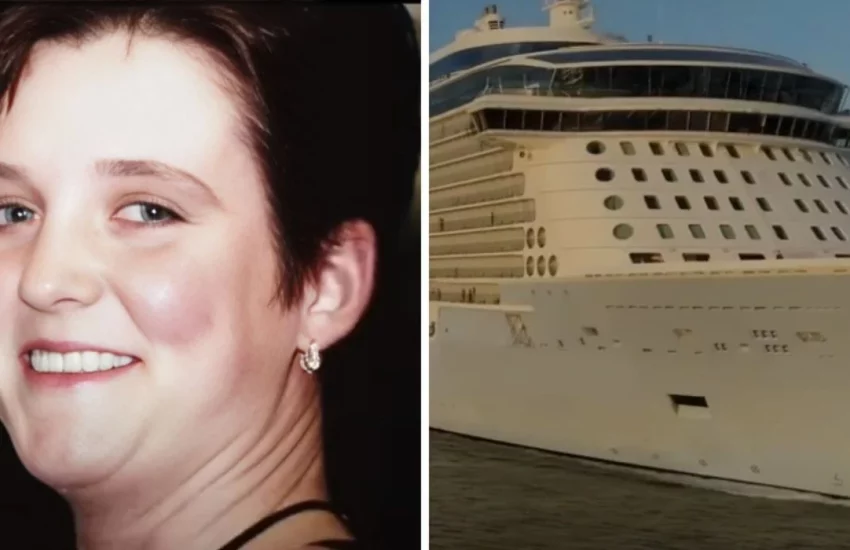
On March 24, 1998, Amy Lynn Bradley, a 23-year-old American woman vacationing with her family on the Rhapsody of the Seas, disappears without a trace. She does not appear to have fallen overboard, left a suicide note, or shown any signs of a struggle. She is simply gone.
What was supposed to be an unforgettable Caribbean cruise turned into a never-ending nightmare. Police investigations, alleged sightings, and the darkest theories, including kidnapping for sexual exploitation, have made this case one of the most shocking unsolved mysteries in cruise history.
More than 25 years after her disappearance, the question remains: What happened to Amy Lynn Bradley? And why, despite the evidence, the leads, and the speculation, has no one ever been able to provide a definitive answer?
Who was Amy Lynn Bradley?
Amy was a 23-year-old woman born on May 12, 1974, in Virginia, United States. She grew up in a close-knit family and was the eldest daughter of Ron and Iva Bradley and sister to Brad, with whom she shared a strong bond. Before her disappearance, Amy had embarked on a promising career in the US Navy, demonstrating determination and discipline.
She was a sociable person, loved by her friends for her outgoing and passionate nature. She loved sports, especially basketball, and had contagious energy. But above all, she was a devoted daughter and sister, deeply attached to her family.
In the summer of 1998, the company the Bradleys worked for gave the family a cruise vacation aboard the Rhapsody of the Seas, a trip that was supposed to be a time of relaxation and fun. No one could have imagined that it would be the beginning of a never-ending nightmare.
That cruise would change everything. Amy would never return home.
On the last night on board, what happened to Amy?
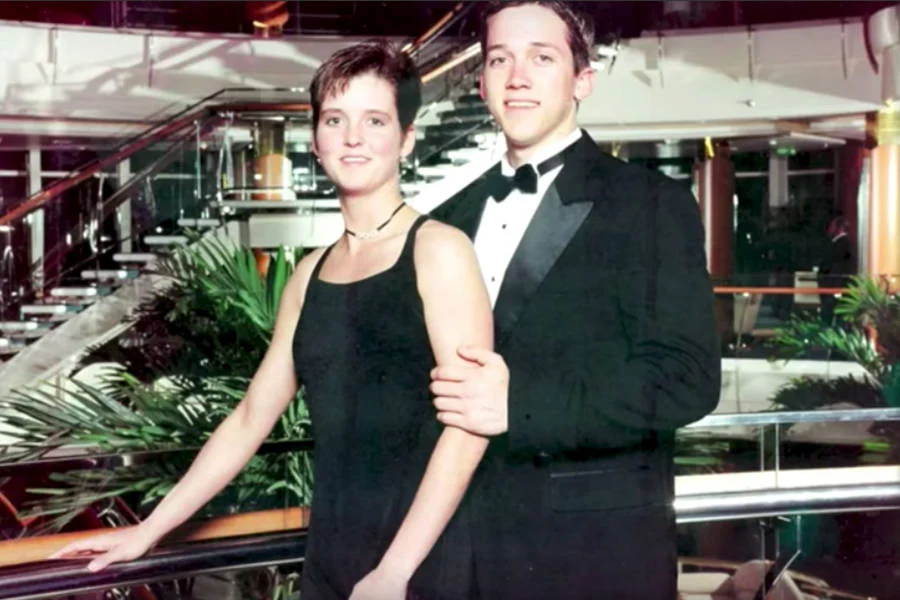
The night between March 23 and 24, 1998, should have been a normal part of the Bradleys’ vacation. After an evening spent with her family, Amy decided to enjoy a few more hours of fun at the ship’s disco. There, according to some witnesses, she met a man, a member of the ship’s musical staff named “Alister,” nicknamed “Yellow.”
Accounts differ as to what happened next. Some passengers said they saw Amy drinking with the man, while others claimed she seemed uncomfortable. What is certain is that she entered the cabin she shared with her family at 3:40 a.m., five minutes after her brother. The two talked for a while on the cabin balcony until her brother decided to go to sleep. Amy said she wasn’t feeling very well and wanted to stay and get some air. At around 5:30 a.m., her father Ron saw her sleeping on the balcony deckchair, but when he woke up half an hour later, Amy was gone.
There were no signs of a struggle, no messages, no traces. Unfortunately, there were not many security cameras and they did not record any movement of the young woman. The initial hypothesis was that she had fallen into the sea, but the circumstances were too suspicious. Too many unanswered questions, too many disturbing coincidences.
The investigation: negligence, omissions, and a case that could perhaps have been solved
From the very first moments after Amy’s disappearance, the investigation was marked by a series of inexplicable acts of negligence. Royal Caribbean, the company that owned the Rhapsody of the Seas, did not immediately halt the ship to allow for a thorough search, instead allowing passengers to disembark as normal in Curaçao, where the ship had docked that morning. This was a fatal delay, allowing any evidence to be scattered or destroyed.
Local authorities and the FBI launched an investigation, but when they arrived on the ship, they discovered that the family’s cabin had been cleaned, removing any clues. According to some people, Amy may have fallen overboard or jumped deliberately, but the authorities in Curaçao seem skeptical. Given the strong sea currents, Amy’s body would have been
Sightings and reports
As the official investigation stalled, a series of disturbing reports continued to emerge from the Caribbean, painting a chilling picture: Amy Lynn Bradley may have been kidnapped and held captive for years.
1. The Curaçao taxi driver (April 1998) – “She was looking for a phone”
Just one month after her disappearance, a taxi driver approached the Bradley family in Curaçao, claiming to have seen Amy on the morning of March 24 while the ship was docked. He said the girl was running around the port parking lot, barefoot, desperately looking for a phone. He described her green eyes, a specific detail in the posters put up to find her, and claimed to have seen her again in other places on the island. The authorities never confirmed the story, but the taxi driver remained a key witness for the family.
2. The divers and Playa Porto Marie beach (August 1998) – “She was staring at me, begging for help”
Two Canadian divers, David Carmichael and a friend, reported seeing a woman with Amy’s tattoos on the beach at Playa Porto Marie, accompanied by two aggressive men, one of whom David recognized as Yellow. When Carmichael spoke in English, the woman turned abruptly, as if to ask for help, but one of the men dragged her away toward the bar. Carmichael described the girl’s tattoos and even the watch Amy was wearing, a gift from her boyfriend. After seeing her photo on TV, he contacted the family and testified, stating, “I’m sure it was her.” The FBI investigated but found no concrete evidence.
3. The officer and the brothel (January 1999) – “My name is Amy, save me!”
William Hefner, a US Navy petty officer, reported meeting a woman in a brothel in Curaçao in 1999. The girl, pale and frightened, approached him whispering, “I’m Amy Bradley, they’re keeping me here against my will.” Hefner, fearing repercussions on his career, did not report the incident until 2002, after his retirement. The FBI investigated, but the brothel had been burned down in the meantime, erasing all traces.
4. The fake Navy SEAL scam (1999-2002) – A cruel joke on the Bradleys
In 1999, a man named Frank Jones contacted the Bradleys, pretending to be a former military man. He said his team had seen Amy being held captive in a compound guarded by armed Colombians, even describing the lullaby her mother used to sing to her. For months, he extorted $210,000 promising a “rescue” that never happened. Arrested in 2002, he confessed to the scam and was sentenced to five years in prison.
5. The anonymous photos (2005) – “Jas,” the sex worker who looked like Amy

In 2005, two photos found on an escort website showed a woman with features very similar to Amy’s, who worked under the name “Jas.” After several studies, a forensic expert asserted that the features matched, but the FBI was unable to confirm the authenticity of the images. Amy had several tattoos, but the photo was taken in a pose that prevented the tattooed areas from being seen. The family appeared on Dr. Phil and showed the photos to the public, claiming that Amy had been sold as a sex slave.
Another sighting dates back to 2005, by a woman who claims to have seen her in Barbados in 2005. The woman was in a restaurant toilet when she heard a man’s voice coming from one of the cubicles. The man came out shortly afterwards with a girl, and while he left the bathroom, the girl stayed behind to wash her hands. The witness tried to talk to the girl, who told her her name was Amy, but then she was frightened by the man. The woman called the police and gave a description of Amy, and it was later discovered that other people had seen the girl in the same area, always in the company of a man.
6. The last lead? Aruba, 2010 – An unanalyzed bone
In 2010, a jawbone was found in Aruba. After ruling out the possibility that it belonged to Natalee Holloway, another tourist who disappeared in the area, the authorities blocked DNA testing, despite the fact that at least nine other tourists had disappeared in the Caribbean.
Every report has pieces of the truth, but no definitive proof. If Amy was kidnapped, why was she never released? If she died in 1998, why do so many “ghosts” continue to haunt the Caribbean?
Until there is an answer, the mystery of Amy Lynn Bradley will remain an open wound in the history of disappearances.
The Amy Bradley case today
Although Amy was declared legally dead on March 24, 2010, 12 years after her disappearance, the Bradleys have always refused to give up the search. Ron and Iva, Amy’s parents, have spent years following every lead, even the most tenuous, convinced that their daughter may still be alive somewhere, held captive by a criminal racket. They have worked with private investigators, appeared on television shows, and kept the media spotlight on the case, but it remains unsolved.
The FBI continues to classify the disappearance as an active cold case, leaving open the possibility that new information may emerge. Over the years, several theories have emerged:
- Kidnapping for human trafficking: Numerous reports from Caribbean brothels, disturbing photos, and witness accounts suggest that Amy may have been the victim of a sex trafficking ring. Some experts believe she was sold multiple times and moved between different islands to cover her tracks.
- Crew involvement: The initial lack of cooperation from Royal Caribbean and the ambiguous behavior of some staff members have fueled suspicions that someone on board was involved.
- Accident or suicide? Although the family categorically rules out this possibility, some investigators have speculated that Amy may have fallen overboard voluntarily or due to illness, although there is no evidence to support this.
What remains to be done?
For the Bradleys, the battle is not over. Even today, anyone with information can contact the FBI in the hope that one day the truth will finally come to light.
“Amy was a girl full of life, she would never have just vanished into thin air,” her father Ron said in an interview. “As long as I have breath in my body, I will keep looking for her.”
Time passes, but the mystery remains. And as the Caribbean waves continue to lap the shores where Amy was last seen, the question remains the same: Where is Amy Lynn Bradley?