 Posted by
 The Sajama Lines, a thousand-year-old labyrinth at the foot of the sacred volcano
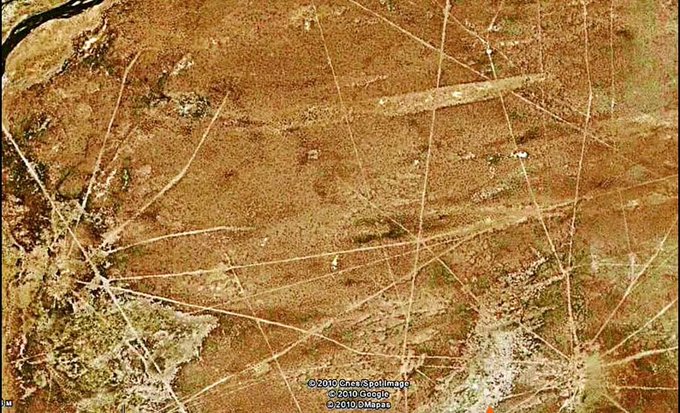
Less famous than the Nazca Lines, but fifty times larger. The Sajama Lines, in the Bolivian highlands, are one of the largest and least known archaeological mysteries in South America. Thousands of perfectly straight paths, some up to 20 kilometers long, intersect in a dense web that extends over 22,000 square kilometers, enveloping the majestic Nevado Sajama, Bolivia’s highest mountain.
Created over 2,500 years ago by ancient Andean cultures, these tracks do not form animal or geometric figures like those in Nazca, but rather an orderly grid, almost an invisible map. What were they used for? Were they ceremonial roads? Pilgrimage routes? A giant astronomical calendar? Or simply paths for grazing llamas?
What is certain is that, despite the hypotheses, no one has yet fully revealed their meaning. Today, thanks to drones and satellites, archaeologists are finally piecing together this puzzle, while climate change and neglect threaten to erase these traces of the past forever.
Sacred geometry in the Andean highlands
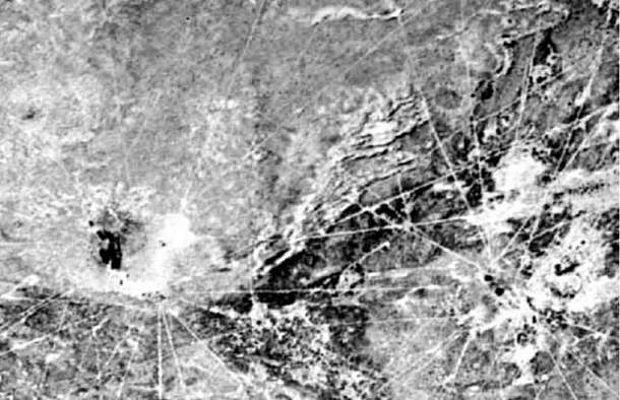
Imagine an infinite canvas, woven not with threads but with earth and stone. The Lines of Sajama are a network of thousands of paths traced on the ground, between one and three meters wide, extending for over 16,000 kilometers in the arid Bolivian highlands. Unlike the famous Nazca geoglyphs, these lines do not form recognizable figures, but are arranged in a dense grid of straight lines, many of which extend for kilometers without deviating, crossing hills and valleys with inexplicable precision.
Created by removing vegetation and digging slightly into the ground, the lines create a contrast between the lighter surface of the exposed soil and the surrounding vegetation. Their arrangement seems to follow a precise order: some point towards the summit of the Sajama volcano, others towards water sources or ancient settlements.
A map without a legend, a system so vast that it can only be appreciated from above or through satellite images. Yet those who drew them could not see them in their entirety. This paradox makes the Sajama Lines one of the most fascinating examples of how ancient civilizations interpreted and shaped the landscape, transforming it into a place of ritual or practical significance that is still shrouded in mystery today.
The lost code of the Aymara cultures
The origins of the Sajama Lines are lost in time, but clues point to the ancient Aymara peoples and perhaps even more remote civilizations. These sacred paths may date back to the pre-Tiwanaku period, between 500 BC and 500 AD, when Andean cultures began to organize the territory with surprising precision.
For Andean communities, the landscape was never just geography: it was a sacred text, a place of dialogue between men and gods. The Nevado Sajama, as a sacred mountain (Apu), may have been the spiritual center of this network of lines, which may have served as:
- Ritual paths for pilgrimages to places of power
- Astronomical alignments related to solstices or agricultural cycles
- Symbolic boundaries between communities or sacred and profane areas
- Caravan routes for the trade of precious goods
Some scholars even speculate that these lines were part of a prehistoric communication system, a sort of three-dimensional territorial map. What is certain is that their construction required a thorough knowledge of the territory and extraordinary social coordination.
Today, the Aymara elders preserve fragments of this memory, recounting how their ancestors “walked following the lines of the gods.” But the true meaning of these traces remains buried under centuries of oblivion, waiting to be fully revealed.
Deciphering a code without keys
Studying the Sajama Lines is an unprecedented archaeological challenge. Unlike other pre-Columbian sites, there are no imposing monuments or ceremonial artifacts here that could reveal their meaning. Scholars are faced with an enigma scattered over a vast territory, where the only traces of human presence are those left in the landscape itself.
The research faces concrete obstacles: extreme altitude (over 4,000 meters), prohibitive climatic conditions, and the absence of direct historical documents. Local communities preserve oral traditions that allude to the lines, but their original meaning has been lost over time.
Modern technologies are opening up new avenues. Satellite remote sensing and drones have made it possible to map the full extent of the system for the first time, revealing previously invisible patterns. The use of LIDAR (Light Detection and Ranging) has identified traces of temporary structures along some routes, suggesting that they were indeed used for ritual movements.
However, every discovery raises new questions. Why do some lines seem to align with particular astronomical events? How were these paths maintained over the centuries?
Tourism and conservation
The Sajama Lines are now at a delicate crossroads between tourism development and conservation needs. While growing international interest could bring economic resources and scientific attention, it also poses a potential threat to this fragile heritage.
The site, which is still poorly equipped to accommodate visitors, suffers from the lack of an integrated management plan. Some lines are already showing signs of deterioration caused by natural erosion, but also by the uncontrolled passage of vehicles and the trampling of the few tourists who venture into this remote region of Bolivia.
Local communities are becoming key players in its protection. Some Aymara villages have started organizing respectful guided tours, following pre-established routes that avoid the most sensitive areas. At the same time, archaeologists and anthropologists are working to urgently document the lines most at risk, using non-invasive techniques such as digital photogrammetry.
The real dilemma is how to reconcile accessibility and protection. Some scholars propose the creation of observation platforms at strategic points, while others insist on the need to limit physical access and promote virtual experiences instead. What is certain is that the Sajama Lines, which have survived for millennia, deserve a conservation strategy that looks to the coming centuries rather than the coming years.
An ancestral message written on the earth
The Sajama Lines are much more than a simple archaeological enigma: they are a unique testimony to the way in which ancient Andean cultures interacted with the land, transforming the plateau into a sacred landscape. While pyramids and temples celebrate the greatness of a civilization through their monumentality, these lines tell a different story, one of relationship with space, of walking and orientation in the cosmos.
Their true importance may lie precisely in their apparent simplicity. They were not built to impress, but to be experienced, traversed, perhaps as part of a collective ritual that united man with nature. At a time when our relationship with the environment is increasingly conflictual, the Sajama Lines remind us that there are alternative, more respectful and harmonious ways of inhabiting the world. Protecting this site means preserving a relic of the past, but also a lesson for the future.
As research continues to decipher their secrets, perhaps the most valuable message they leave us is this: sometimes, the most significant traces are not the most conspicuous ones, but those that speak to the heart with the silent language of the earth and time.