 Posted by
 Chicago, 1924. The Roaring Twenties in America, an era of prosperity and optimism, was shaken by a crime so aberrant and incomprehensible that it was immediately dubbed by the press as the “crime of the century.” It was not a robbery gone wrong, nor a gangland feud. It was a gratuitous murder, planned and carried out by two brilliant, wealthy young men from good families: Nathan Leopold and Richard Loeb.
Help Emadion grow, click here.
Geniuses and the theory of the “superman”
Nathan Leopold, 19, was a recognized genius. With an estimated IQ of 210, he was an ornithologist of already established renown, spoke five languages fluently, and had studied ten others. Richard Loeb, 18, was also a prodigy: the youngest graduate of the University of Michigan. Charming and athletic, Loeb was, however, described as “lazy” and “obsessed with crime.”
The two, bound by a homosexual relationship, were united by a perverse intellectual symbiosis. Leopold was fascinated by Friedrich Nietzsche’s philosophy and his idea of the “Übermensch” (the Superhuman). He interpreted this figure in a distorted way, convincing himself that superior men like him and Loeb were above the law and common morality. “Legal obligations do not apply to those who approach the ‘superman’,” he argued.
On the other hand, his devotion to Loeb was absolute. When asked about his motive, Leopold replied, “To the extent that I had one, it was to please Dick.” Loeb, the alleged ‘mastermind’ of the operation, took advantage of this devotion to manipulate him. A psychiatrist at the trial described them as a supreme case of “folie à deux” (madness for two).
The plan and the murder
 Robert Franks with his father, photographed between 1920 and 1923. The young Franks was the victim of the notorious crime committed by Nathan Leopold and Richard Loeb in Chicago in 1924.
Source: Federal Archives, image 102-00651A / CC-BY-SA 3.0 (Deutsches Bundesarchiv).
For months, the two meticulously planned what they called the “perfect crime.” The goal was to kidnap and kill a teenager, with no motive other than pure intellectual challenge and the thrill of transgression. On May 21, 1924, after renting a car under a false name, they chose their victim: Bobby Franks, a 14-year-old boy who was their neighbor and Loeb’s cousin.
After luring him into the car under false pretenses, Loeb struck him fatally in the head with a crowbar. The crime was quick and brutal. To throw off the investigation, they took the body to a wooded area, stripped it, and doused his face and genitals with hydrochloric acid in an attempt to make him unrecognizable and hide the fact that he was a circumcised Jew. They then sent a ransom note to the Franks family, a cunning plan that turned out to be another failure.
The downfall: a pair of glasses
Despite months of planning, their ‘perfect crime’ unravelled due to a trivial oversight. At the scene of the crime, Nathan Leopold dropped his glasses. These were not just any glasses, but ones with a particularly rare hinge, which was easily traced back to him.
When questioned, their excuses quickly fell apart. Loeb confessed first, trying to pin the blame for the murder on Leopold. Then Leopold confessed too, claiming the opposite. Their versions coincided on one point: they had done it for the thrill, to prove they were Supermen above the law.
The trial and legacy
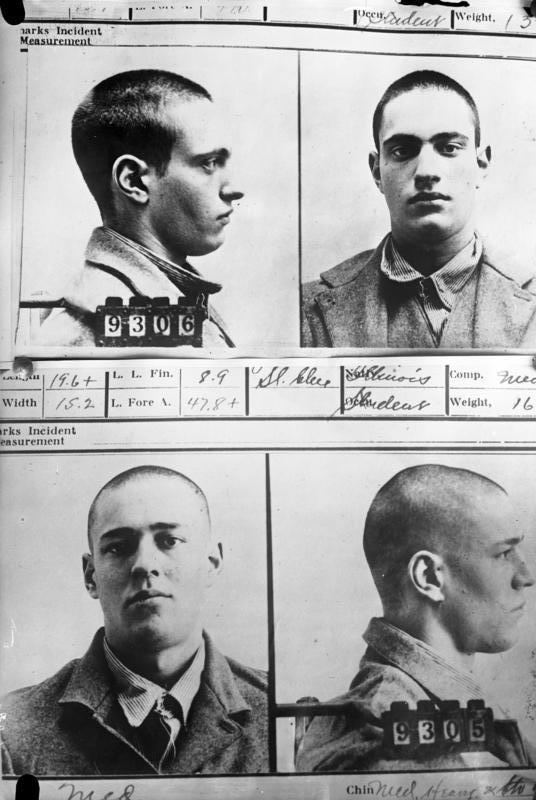
Prison portraits of Nathan Leopold (top) and Richard Loeb (bottom), taken in 1924 in the United States, after they were sentenced to life imprisonment for the murder of young Robert Franks.
Source: Federal Archives, image 102-12794 / CC-BY-SA 3.0 (Deutsches Bundesarchiv).
The trial became a media phenomenon. The families hired America’s most famous lawyer, Clarence Darrow, a staunch opponent of the death penalty. Knowing that a jury trial would almost certainly result in a death sentence, Darrow made a bold move: they pleaded guilty, turning the trial into a sentencing hearing.
For 32 days, Darrow fought not to exonerate them, but to save their lives. His eight-hour closing argument is a historic plea against capital punishment. He succeeded: the two avoided hanging and were sentenced to life imprisonment plus 99 years.
Their story did not end in prison. In 1936, Richard Loeb was killed by an inmate with a razor in what was presented as an attempted sexual assault. Leopold, on the other hand, devoted himself to redemption. He reorganized the prison’s educational system, volunteered as a guinea pig for medical experiments, and, after 33 years, was granted parole. He moved to Puerto Rico, where he remarried, worked as a medical technician, and continued his ornithological studies, dying in 1971.
The dark fascination
The story of Leopold and Loeb has inspired countless works, from Patrick Hamilton’s play Rope (later adapted by Alfred Hitchcock) to Meyer Levin’s novel Compulsion, from the musical Thrill Me: The Leopold and Loeb Story to the Better Call Saul episode “Plan and Execution.”
Their story continues to fascinate because it represents a disturbing enigma: how can the sharpest intelligence, combined with every material privilege, deviate towards the most absolute and gratuitous evil? Theirs was not just a murder, but a failed philosophical experiment, the tragic demonstration that genius, without a moral compass, can only build horror.
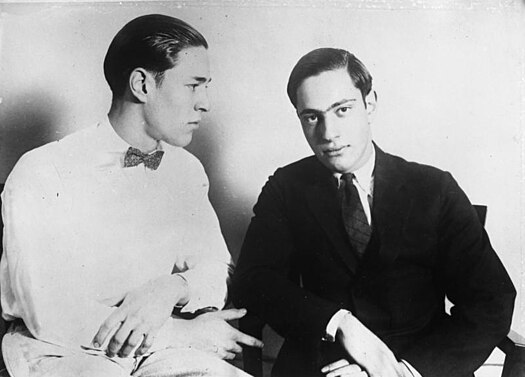
Cover image: Nathan Leopold (right) and Richard Loeb (left), students at the University of Chicago, photographed in August 1924 during the famous trial for the murder of Robert Franks.
Source: Bundesarchiv, Bild 102-00652 / CC-BY-SA 3.0 (Deutsches Bundesarchiv).