 Posted by
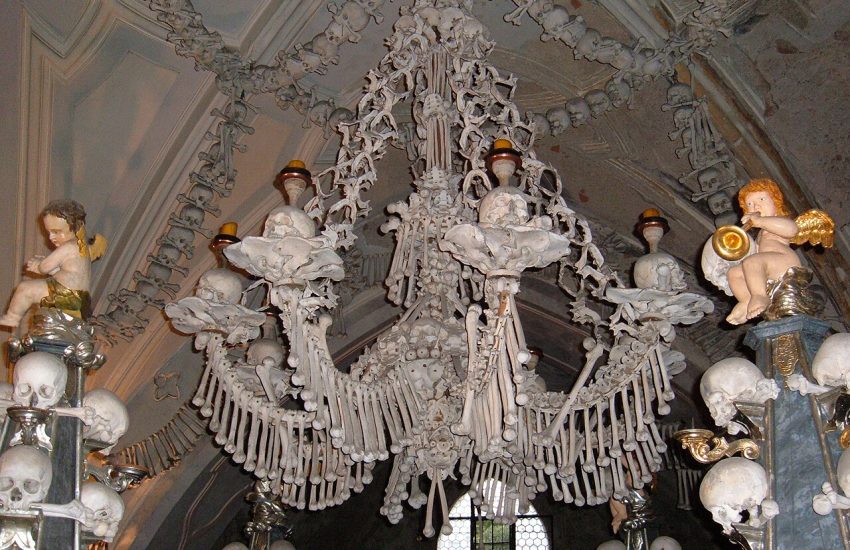
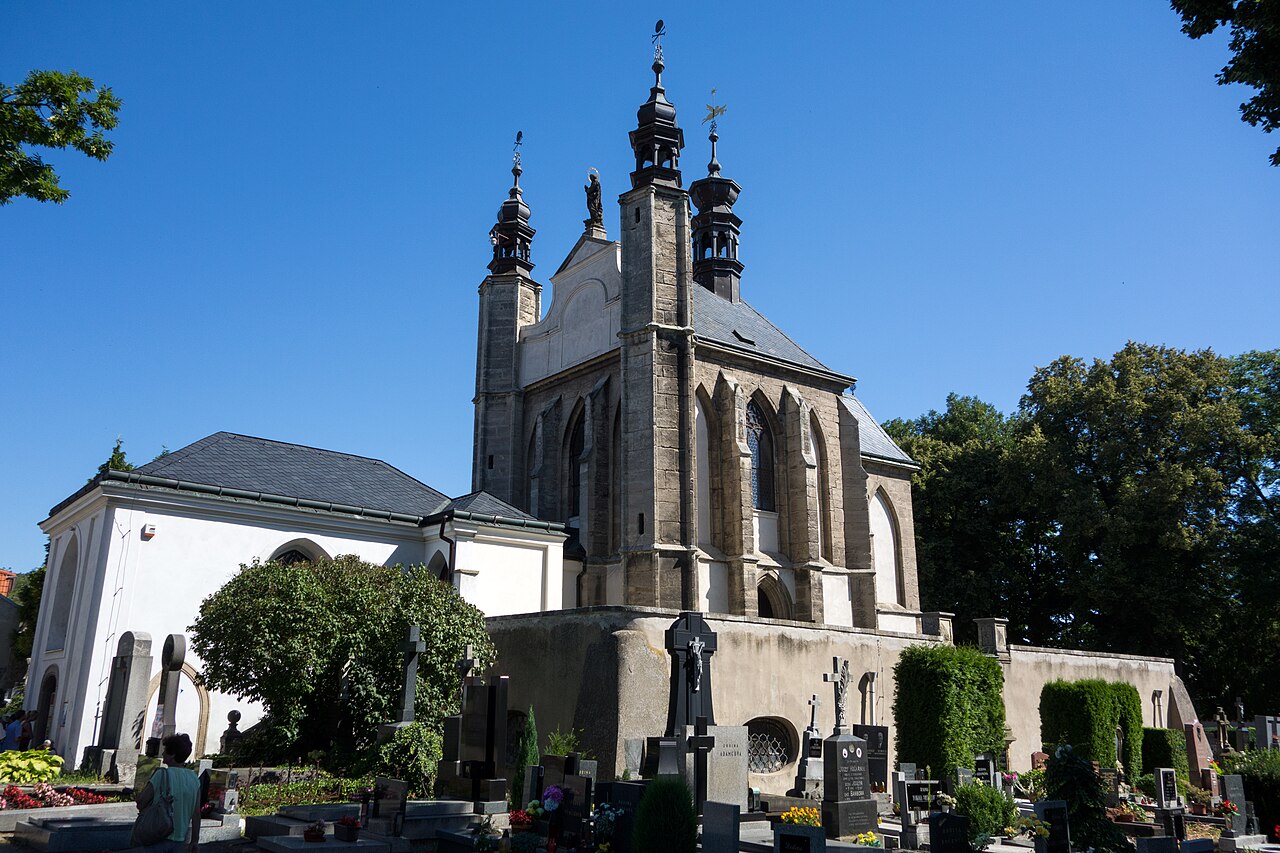
Outside, it is an ordinary Bohemian morning: a tidy cemetery, candles flickering on the graves, a small Gothic church with two pointed towers. You walk down a few steps and the air changes. It is colder, with a faint smell of lime and damp stone. Then you look up, and from a white vault hangs an enormous chandelier. It is not made of crystal or wrought iron, but of human bones: femurs, vertebrae, jawbones, shoulder blades, and skulls holding candles as if they were trays.
Welcome to the Sedlec Ossuary in Kutná Hora, about an hour from Prague. Here lie – or rather, are displayed – the remains of tens of thousands of people. It is one of the most photographed places in the Czech Republic and, in these days between All Saints’ Day and All Souls’ Day, one of the best places to ask ourselves how we relate to death. one by one.
A handful of holy soil
The story begins with a monastery. In 1142 a group of Cistercian monks settled in Sedlec, on land donated by the nobleman Miroslav of Markvartice. It was the first Cistercian house in Bohemia, and over the centuries it grew very rich, partly thanks to the silver mines that made Kutná Hora’s fortune.
In 1278 King Ottokar II of Bohemia sent the monastery’s abbot, Jindřich (Henry), to the Holy Land. On his return, tradition says, the abbot brought back a handful of soil from Golgotha and scattered it over the abbey cemetery. Some Czech sources speak instead of soil from Akeldama, the “field of blood” in Jerusalem linked to Judas and used to bury strangers. Whichever version is right, the result was the same: in the eyes of the faithful, that corner of Bohemia became a fragment of the Holy Land.
The news spread across Central Europe. Being buried in Sedlec meant resting in holy ground in the most literal sense. People even came to believe that bodies decomposed faster in that soil, as if the earth itself hastened the passage to the afterlife. Families from Bohemia, Poland, Bavaria and beyond asked to bury their loved ones there.
Famine, plague and war: a cemetery that was never big enough
Then came the catastrophes. In 1318 a severe famine struck the region; thirty years later, in 1348, the Black Death swept across Europe. Chronicles and modern sources speak of some thirty thousand burials in the Sedlec cemetery during those terrible years. In the following century, the Hussite Wars added thousands more dead, and the monastery itself was devastated.
This is not just legend. Since 2016, archaeologists digging around the ossuary have found 34 mass graves holding about 1,200 skeletons: roughly half victims of the 1318 famine and half of the 1348 plague. Experts have called it the largest find of its kind in Europe, larger even than the famous plague cemetery at East Smithfield in London.
The bones also tell us who these people were. According to archaeologist Jan Frolík, adult men were relatively few, around 30%: a sign of a mining community with constant turnover, where workers arrived from elsewhere to seek their fortune in the silver mines. Adults and children were found in similar numbers, and the skeletons bear the typical marks of medieval life: badly healed fractures, tuberculosis, meningitis.
In short, the cemetery filled up faster than it could be emptied. Room had to be found for yesterday’s dead to make space for tomorrow’s.
A two-storey church and a half-blind monk
Around 1400, a Gothic church dedicated to All Saints was built in the middle of the cemetery. It is a two-level building, a type of funerary architecture known in Central Europe as a karner: the upper chapel for worship, the lower one for bones. During the digging of the foundations, and whenever part of the cemetery was cleared, the exhumed bones ended up below.
For a century they lay in heaps with no particular order. Then, after 1511, the most mysterious figure in this story appears: a half-blind Cistercian monk whose name we do not know. Tradition holds that he exhumed the skeletons and stacked the bones into six great pyramids. Why a nearly blind monk? The sources don’t say. Some have seen it as a form of penance, others as a task given to someone who could no longer read or copy manuscripts. But the detail may also have grown over time, as happens with many monastic legends.
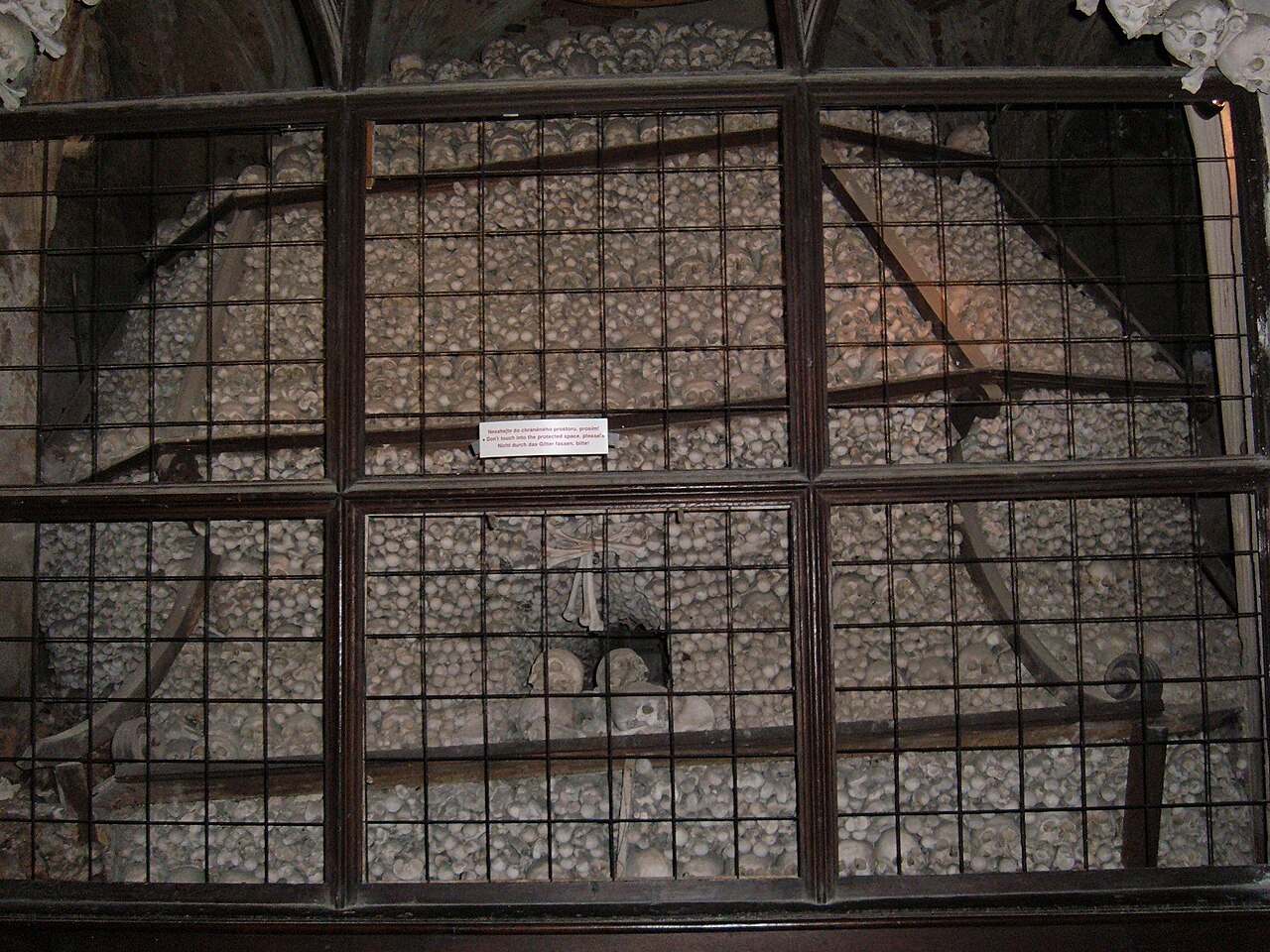
Four of those pyramids still exist today, in the corners of the chapel: bell-shaped mounds several metres high, made of thousands of skulls and long bones patiently fitted together.
Santini and “Gothic” Baroque
In the early eighteenth century the church had a problem: its front wall was leaning dangerously. Between 1703 and 1710 the work was entrusted to Jan Blažej Santini-Aichel, a Prague architect of Italian descent famous for a unique style that blends Baroque and Gothic. Santini added a new entrance that acts as a buttress and redesigned the upper chapel. According to the Czech press, the tower still leans by about fifty centimetres.
A few decades later came another turning point. In the 1780s Emperor Joseph II, in the midst of his reforms, dissolved hundreds of monasteries across the Empire. Sedlec was closed too, and its estates passed to the noble Schwarzenberg family, who turned part of the former abbey into a tobacco factory. The ossuary, however, remained.
František Rint, the woodcarver of bones
In 1870 the Schwarzenbergs decided to bring order to this store of human remains. For the job they chose a woodcarver, František Rint, from Česká Skalice. He is the artist who gave the ossuary the look we know today.
Rint kept four of the monk’s six pyramids and used the bones of the other two to create a true set of sacred furnishings. The most famous piece is the chandelier in the centre of the nave, about two and a half metres wide, which according to an often-repeated tradition contains at least one of every bone in the human body. Garlands of skulls and vertebrae hang from the vault. On either side of the entrance stand two great chalices made of femurs, pelvises and sacral bones, topped with skulls. Near the altar are two monstrances: where the host would be, at the centre of the rays, there is a skull.
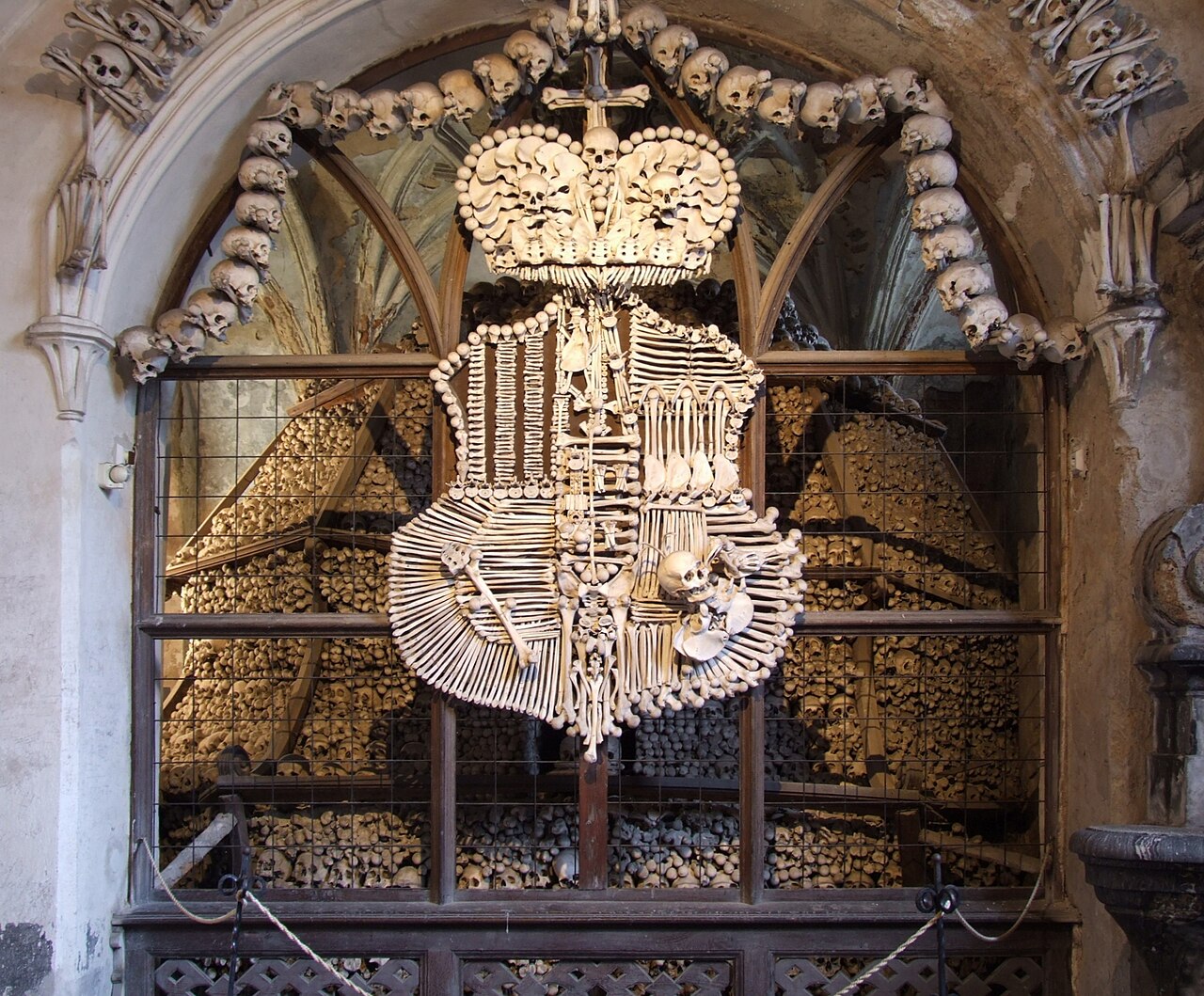
Perhaps the most astonishing work, though, is the Schwarzenberg coat of arms, rebuilt entirely out of bones. It commemorates a military victory in 1598, when Adolf von Schwarzenberg took the fortress of Győr from the Ottomans: in one quarter a raven pecks at the eye of a Turk’s head. The head is a real skull; the raven is made from hand and wrist bones.
And then there is the signature. On the wall near the entrance, Rint left his name and the date, 1870, also spelled out in bones. It is a detail that strikes visitors even more than the chandelier: a craftsman signing his work with the remains of strangers, as a painter would in the corner of a canvas.
Macabre or sacred? The meaning of a memento mori
People entering Sedlec for the first time often react with a mix of fascination and unease. Is it a macabre place? By today’s standards, probably. But for those who created it, it meant something else.
Ossuaries were common throughout Catholic Europe, from the Alps to Bohemia. When cemeteries ran out of space, bones were exhumed and kept in consecrated places rather than scattered. Arranging them into decorative shapes was not a mockery, but a way to remind the living of two ancient truths: death comes for everyone, and before it, rich and poor end up in the same pile. This is the heart of the memento mori, “remember that you must die”.
Scholars of funerary art, such as historian Paul Koudounaris, have pointed out that those pyramids of skulls were also meant as a kind of “heavenly mountain”: an image of the community of the dead awaiting resurrection. Rint, in the heart of the nineteenth century, added an almost theatrical flair to that tradition, which still divides visitors today.
The stolen skull and other visitors’ tales
Like every place of its kind, Sedlec has gathered stories around it. The best known was reported by the Czech press: in the early 1990s an American tourist is said to have secretly taken a skull as a souvenir. Some time later he sent it back, with a letter of apology explaining that ever since he had taken it, nothing but misfortune had come his way.
Coincidence, suggestion, guilt? It is impossible to say. A sceptic will note that memory picks out bad events when we are looking for an explanation, and that anyone who takes human remains home has good reason to feel uneasy. And yet the story keeps circulating, and it is hard not to think of it when you are standing a few centimetres from those empty eye sockets.
Many visitors also describe a particular silence, a sense of “presence” that is not frightening but makes you instinctively lower your voice. There is no reliable evidence of paranormal phenomena linked to the ossuary. There is, however, the awareness of standing among tens of thousands of lives: miners, children, victims of hunger and plague. Perhaps that is enough.
The ossuary on screen
Sedlec has fascinated artists and filmmakers too. In 1970, for the centenary of Rint’s work, the master of surrealist animation Jan Švankmajer made a short film simply titled Kostnice (“The Ossuary”). The original version, narrated by a bored tour guide, displeased the communist authorities of the time and was initially censored.
Since then the ossuary has appeared in documentaries, music videos and genre films, and has become a fixture of so-called “dark tourism”, the kind of travel that takes people to places associated with death and tragedy.
A restoration, bone by bone
Such fame comes at a price. Decades of neglect during the communist era, humidity and contact with millions of visitors – some of whom touched the bones or posed next to them – damaged the displays. Over the centuries the pyramids even sank, as the bones at the base crumbled under the weight.
In 2014 the parish launched a restoration expected to last many years. The method is slow and almost devotional: the bones are removed, brushed, dried and soaked in a lime solution, the same preservation technique used centuries ago. Head restorer Tomáš Král has explained that the aim is to put everything back as Rint left it.
In June 2024 the first pyramid was completed: the one in the north-west corner, about five metres tall. To lighten the load, the restorers built a wooden structure inside it to support the various “floors” of bones. Fragments that could not be saved were respectfully buried, without being replaced by casts or copies. This single pyramid cost about 21 million Czech crowns, and the whole project has exceeded 110 million.
Visiting Sedlec today
The ossuary stands in the Sedlec district, a few minutes from Kutná Hora railway station. Since 1995 the town has been a UNESCO World Heritage Site, together with the Church of St Barbara and the Cathedral of the Assumption at Sedlec, the latter right next to the old monastery.
In the years before the pandemic, the ossuary welcomed almost half a million visitors a year; in 2022 there were about 297,000. During the works some areas may be closed or protected by glass panels, through which you can watch the restorers at work. Check opening hours and tickets on the official website before you go, as they change with the seasons.
One piece of advice applies to every burial place: go in quietly, touch nothing, and remember that every skull was once a person. Sedlec is not a horror set, but a church and a cemetery that are still consecrated.
The soil that does not forget
When you climb back to the surface, the November light seems brighter. Outside, the modern graves have names, dates, photographs. Beneath our feet, tens of thousands of people have lost all that and become something else: a chandelier, a garland, a coat of arms.
Perhaps Abbot Jindřich really did bring that handful of soil from Jerusalem, perhaps not. But something in Sedlec worked as he had hoped: this cemetery has never been forgotten. And every year, when the candles are lit for All Saints, it is as if that soil were still asking the living to remember.
Sources
- Sedlec Ossuary – Wikipedia
- V Kutné Hoře mají z kostí lustr i erb – Novinky.cz
- Over 1,000 skeletons discovered during renovation of Kutná Hora “bone church” – Radio Prague International
- Human skull pyramid in Czech chapel fully restored – Expats.cz (2024)
- Czech ‘Bone Church’ at Sedlec Ossuary continues years-long restoration – Expats.cz
- Czech Ossuary Will Be Cleaned and Conserved – Archaeology Magazine
- The charnel delights of Sedlec Ossuary – Strange Remains
- Kutná Hora – Sedlec Ossuary – VisitCzechia
Featured image: the bone chandelier of the Sedlec Ossuary. Photo: BrokenSphere – Wikimedia Commons – CC BY-SA 3.0