 Posted by
Before pumpkins, there were turnips. And before that, there was Jack: a man who, according to Irish folklore, tricked the Devil twice and was turned away by both Heaven and Hell. Ever since, he is said to wander the dark with a burning coal inside a hollowed-out turnip. In this article we retrace the legend, the versions collected from Irish country people, the mysterious bog lights that gave it its name, and we discover that Italy had its own “pumpkins of the dead” long before Halloween arrived.
Picture a dirt road in rural Ireland on a late October night a hundred years ago. No streetlights, just fog rising from the bog and the sound of your own footsteps. Suddenly, ahead of you, a light flickers on. Small and trembling, like a lantern. It looks like someone walking down the road. You take a few steps towards it and the light moves. It goes out. It comes back on a little further away, towards the marsh.
If you had asked one of the old locals what you had seen, they would probably have answered with a single name: Jack. Jack of the Lantern. The man wanted neither in Heaven nor in Hell.
It is from him, a figure halfway between a pub yarn and a ghost story, that the Halloween pumpkin gets its English name: jack-o’-lantern. But his story is much stranger, older and more surprising than you might think. And, as we will see, it leads all the way to Italy.
Who was Stingy Jack
In the best-known version, Jack is an ordinary Irishman, sometimes a blacksmith, always a drunkard, a liar and above all a miser. Hence the nickname Stingy Jack. He is neither a hero nor a monster: he is the village trickster, the kind who would find a way not to pay his tab even at the bar of Hell.
And that is exactly where it all starts. One evening Jack invites the Devil for a drink. When it is time to pay, he has no intention of reaching for a coin. So he makes the Devil an offer: turn yourself into a coin, settle the bill, then change back. The Devil, who knows why, agrees.
But instead of paying, Jack slips the coin into his pocket, right next to a small silver cross. The Devil is trapped: the cross stops him from returning to his true form. To get out he has to bargain, and Jack sets the terms. He will let him go only if the Devil leaves him alone for a while (one year in some versions, ten in others) and, above all, if he never claims his soul when he dies.
When the time is up, the Devil comes back. And Jack fools him again. As a last wish, he asks him to climb a tree, often an apple tree, to pick a piece of fruit. Once the Devil is among the branches, Jack carves a cross into the bark, or places crosses around the trunk. The Devil cannot climb down. To be freed, he must promise once more: Jack’s soul is off limits, forever.
There is also a version in which Jack is a thief chased by villagers. Meeting the Devil, he suggests he turn into a coin to pay for the stolen goods, so that when the coin vanishes the villagers will start brawling among themselves. Here too the coin ends up in a purse next to a cross, with the same result.
Neither Heaven nor Hell
Like everyone, Jack eventually dies. He shows up at the gates of Heaven, but a life of drinking, cheating and greed is not the best reference: he is turned away. So he goes down to Hell, and this is where the legend turns bitter. The Devil keeps his word. He cannot take Jack’s soul, and he does not want it anyway.
Jack is left outside both worlds, in the dark. He asks for at least something to see where he is going. The Devil, with contempt, tosses him a burning ember straight from the fires of Hell. Jack, who happens to have a turnip with him, hollows it out, puts the coal inside and walks off with his makeshift lantern.
From that day, tradition says, he has roamed the earth with no rest. The Irish started calling him “Jack of the Lantern”. Over time the name was shortened to Jack-o’-Lantern.
The many faces of Jack: what the Irish really told
The “textbook” version you just read is the one found in books and websites today. But the oral tradition was far more varied, and luckily we can listen to it almost first-hand.
Between 1937 and 1939 the Irish Folklore Commission asked primary school children across the country to collect stories, beliefs and superstitions from their grandparents and neighbours. The result is the Schools’ Collection, now available online at dúchas.ie: thousands of handwritten copybooks. And Jack of the Lantern turns up in a great many of them.
In a story from County Offaly, Jack is a man who falls out with his wife, leaves home in search of work and dies without finding any. Saint Peter tells him there is no room in Heaven, Purgatory will not have him, and when he reaches the gates of Hell the Devil strikes him in the face, leaving a red mark. That mark is the light we see wandering about: whoever follows it goes astray.
A version from County Waterford is almost comic: turned away by Saint Peter, Jack is sent to Purgatory, where he is told to “step a little lower”, because there is a cheaper lodging house down below. In Hell the Devil brands his nose with a red-hot poker, and ever since Jack has gone about with a lantern hanging from his burnt nose.
In other accounts Jack has no story at all: he is simply a presence. A boy “not good enough for Heaven and not bad enough for Hell”, as a schoolgirl from County Galway put it, who is seen at night in the bogs. Or a little man with a lantern who appears on marshy ground.
And here is an interesting detail. Almost all these accounts agree on one thing: Jack is not harmless. His light deceives, dazzles and leads people astray. A story from Wexford says some who tried to follow it lost their lives. There was also a remedy, repeated in several counties: if you notice a light leading you off your path, turn your coat inside out.
An account from Tipperary tells of a man named Patrick Dwyer who, coming home late, saw a light approaching and thought it was a bicycle. The light vanished, and he could no longer find his way home: he walked up and down the road until six in the morning. At daybreak he found himself right in front of his own gate.
What Patrick Dwyer really saw that night, nobody can say. But legends are born from stories like his.
Before pumpkins: the turnips that frightened people
Today Halloween means smiling orange pumpkins. But in the 19th-century British Isles the scene was far more unsettling.
Historian Ronald Hutton, one of the leading scholars of the British ritual year, documents that in the 19th century parts of England, Ireland, Wales and Scotland used hollowed-out turnips or mangel-wurzels at Halloween, often carved with grotesque faces. In Somerset, Punkie Night is still celebrated today with lanterns made from mangel-wurzels. In Worcestershire, as early as the late 18th century, there are references to “Hoberdy’s Lantern”, turnip lanterns linked to a spirit called Hob.
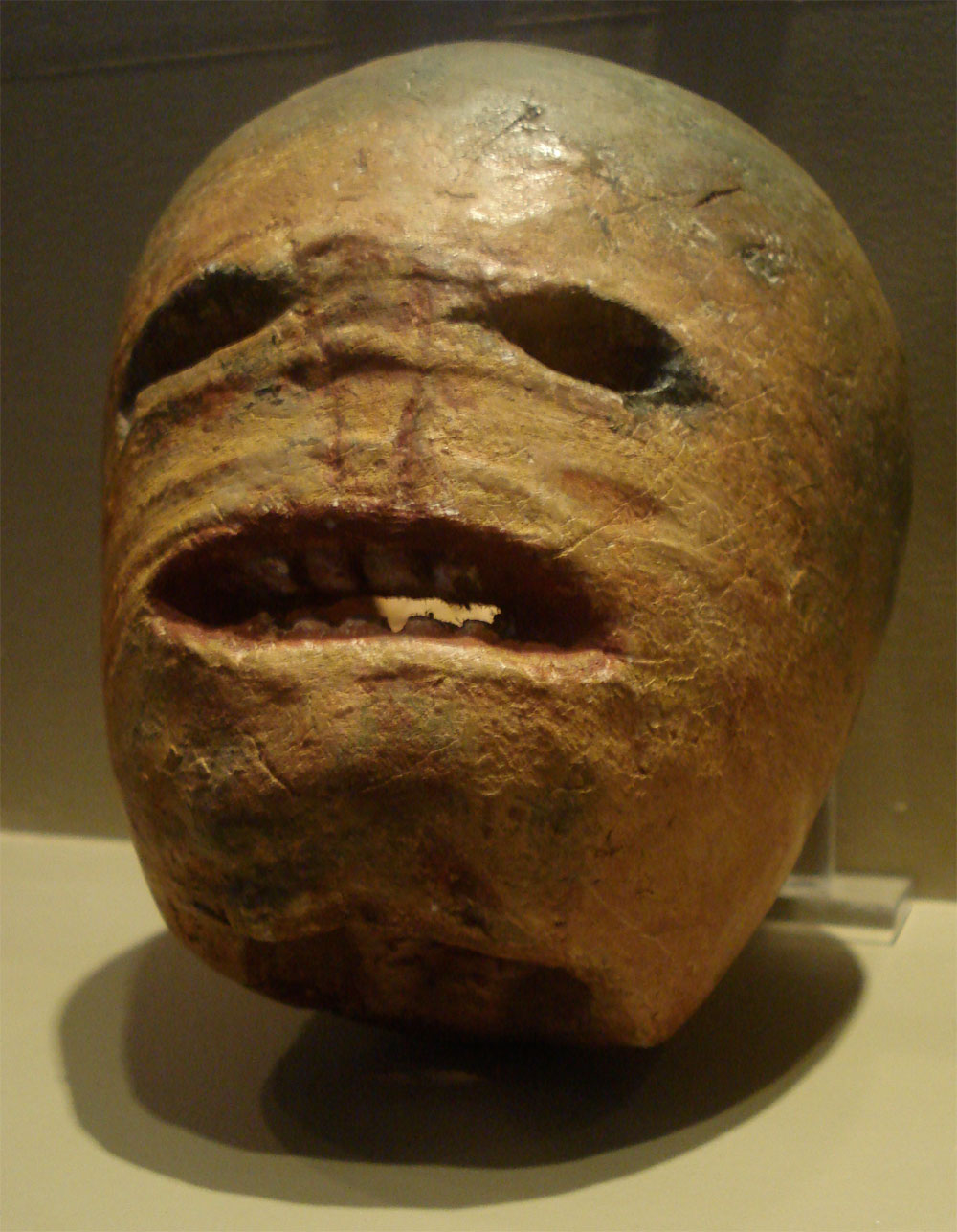
The most famous piece of this tradition is kept at the National Museum of Ireland – Country Life in County Mayo. It is simply called the “ghost turnip”. In 1943 a schoolteacher working near Fintown, County Donegal, Róis Ní Bhraonáin, donated a turnip lantern to the museum, explaining that it was the kind always made in the area around 1900. Even then, nobody made them anymore.
The original was rotting, so museum artist Eileen Barnes made a painted plaster cast of it. That is what visitors see today: a hollow face with narrow eyes and a mouth full of teeth. Nothing like a smiling pumpkin. When a photo of it went viral a few years ago, many found it scarier than any modern decoration.
What were they for? Scholars have recorded different explanations. According to some accounts, the lanterns represented the spirits themselves or the supernatural beings believed to roam on the night of Samhain, the Celtic new year. According to others, they were placed on windowsills precisely to keep evil spirits away. And quite often young people simply used them to scare passers-by. It has also been suggested that they represented souls in Purgatory, since Halloween is the eve of All Saints’ Day and comes two days before All Souls’ Day.
Some go even further back, linking the carved heads to the ancient Celtic cult of the severed heads of enemies, displayed as protection. It is an evocative idea, but it should be taken with great caution: there is no direct evidence of an unbroken thread between Celtic warriors and 19th-century turnips.
The name comes from the bog
Here is a detail almost nobody mentions. The name jack-o’-lantern was not coined for a pumpkin, nor even for a turnip.
According to the Oxford English Dictionary, the term was used in Britain as early as 1658 for the will-o’-the-wisp, in Latin ignis fatuus, “foolish fire”: the mysterious flickering lights seen over marshes and bogs. Between 1663 and 1704 the same name also referred, more prosaically, to a man with a lantern or a night watchman. Only in 1837 does the dictionary record the word being used for a carved lantern.
The construction is identical to another name for the same phenomenon, will-o’-the-wisp, “Will with the torch of straw”. Will, Jack, sometimes even Meg: everyday names, anybody’s names, given to a light that seemed to have a will of its own.
On 16 January 1836 the Dublin Penny Journal published a long tale about the legend of “Jack-o’-the-Lantern”. That version, however, mentions no vegetable at all. This suggests that Jack’s story first arose as an explanation for the lights in the bogs, and that the carved turnip attached itself to the legend later on.
Lights in the marsh: what science says
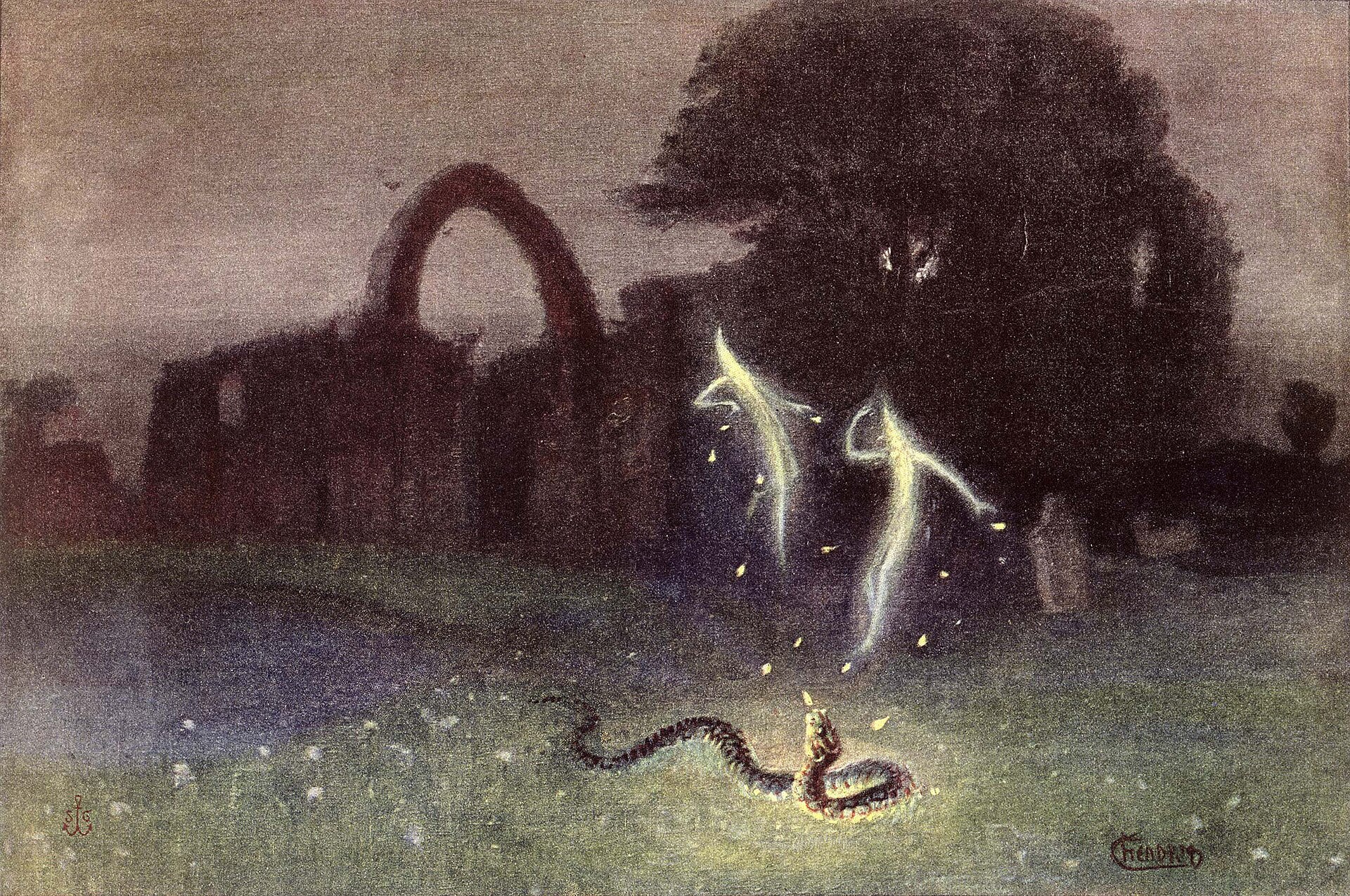
So what were Irish country people actually seeing over the bogs? The long-standing explanation is chemical. Organic matter decomposing without oxygen, as in marshes or, in the past, in cemeteries with shallow graves, produces gases such as methane and phosphine. Phosphine can ignite spontaneously in air and in turn set the methane alight, producing small floating flames.
The problem is that this explanation does not quite fit. Italian chemists Luigi Garlaschelli and Paolo Boschetti, testing it in the lab, observed that flames produced this way tend to be greenish, while historical descriptions of the wisps speak of bluish or yellowish lights.
In 2025 a team of chemists at Stanford University led by Richard Zare proposed a new hypothesis, published in the journal PNAS. By bubbling air and methane through water and filming the bubbles with high-speed cameras, the researchers observed tiny electrical discharges between them, which they called “microlightning”. These sparks could be enough to ignite methane with no other trigger. Other scientists consider it a convincing explanation, though not necessarily the final word.
There are other hypotheses too: bioluminescent fungi in rotting wood, pale-feathered barn owls reflecting moonlight, geological phenomena. And there is a curious fact: reports of will-o’-the-wisps have become extremely rare over the last century, perhaps because so many wetlands have been drained.
One small detail remains that none of these explanations fully settles: why did so many witnesses say the lights seemed to move away as they approached? Perhaps it is just the air you displace, or perspective in the dark. Perhaps. But it is easy to see why, for centuries, some people preferred to call them Jack.
The voyage to America: when the turnip became a pumpkin
In the mid-19th century the Great Famine drove more than a million Irish people across the Atlantic. Their stories and Halloween customs travelled with them. In America they found a vegetable much bigger, softer and far easier to carve than a turnip: the pumpkin.
Americans were in fact already carving pumpkins, but without any link to Halloween. In 1850 the poet John Greenleaf Whittier recalled in a poem the ugly faces he carved into pumpkin rinds as a boy, lit by a candle, yet connected them to Thanksgiving. As late as 1895 a New York Times article suggested giving a lit jack-o’-lantern as a prize in children’s Thanksgiving games.
The first documented link between carved pumpkins and Halloween comes from Canada: on 1 November 1866 the Daily News of Kingston, Ontario, reported masked youngsters roaming the streets the night before and a real “sacrifice of pumpkins” turned into glowing heads. In 1885 an American children’s magazine contrasted the great British Halloween bonfires with the grinning pumpkins loved by American boys.
And the Headless Horseman? In illustrations and films of The Legend of Sleepy Hollow he often carries a lit pumpkin in place of his head. But in Washington Irving’s original 1820 tale there is no jack-o’-lantern and no Halloween: the morning after Ichabod Crane disappears, all that is found is a shattered pumpkin next to his hat. Popular imagination added the rest.
Then, as so often happens, the tradition came full circle and returned to Europe in its American form. Today, even in Ireland and Scotland, the pumpkin has almost completely replaced the turnip, although every year someone tries to bring back the old “tumshie”, as the Scots call it.
Pumpkins of the dead: Italy’s own Halloween
Every year in Italy, as regular as pumpkins in the supermarket, the same debate returns: Halloween is an imported American holiday with nothing to do with local traditions. Jack’s story shows how little of it is actually American. But there is more: Italy had its own carved pumpkins, and in some places it still does.
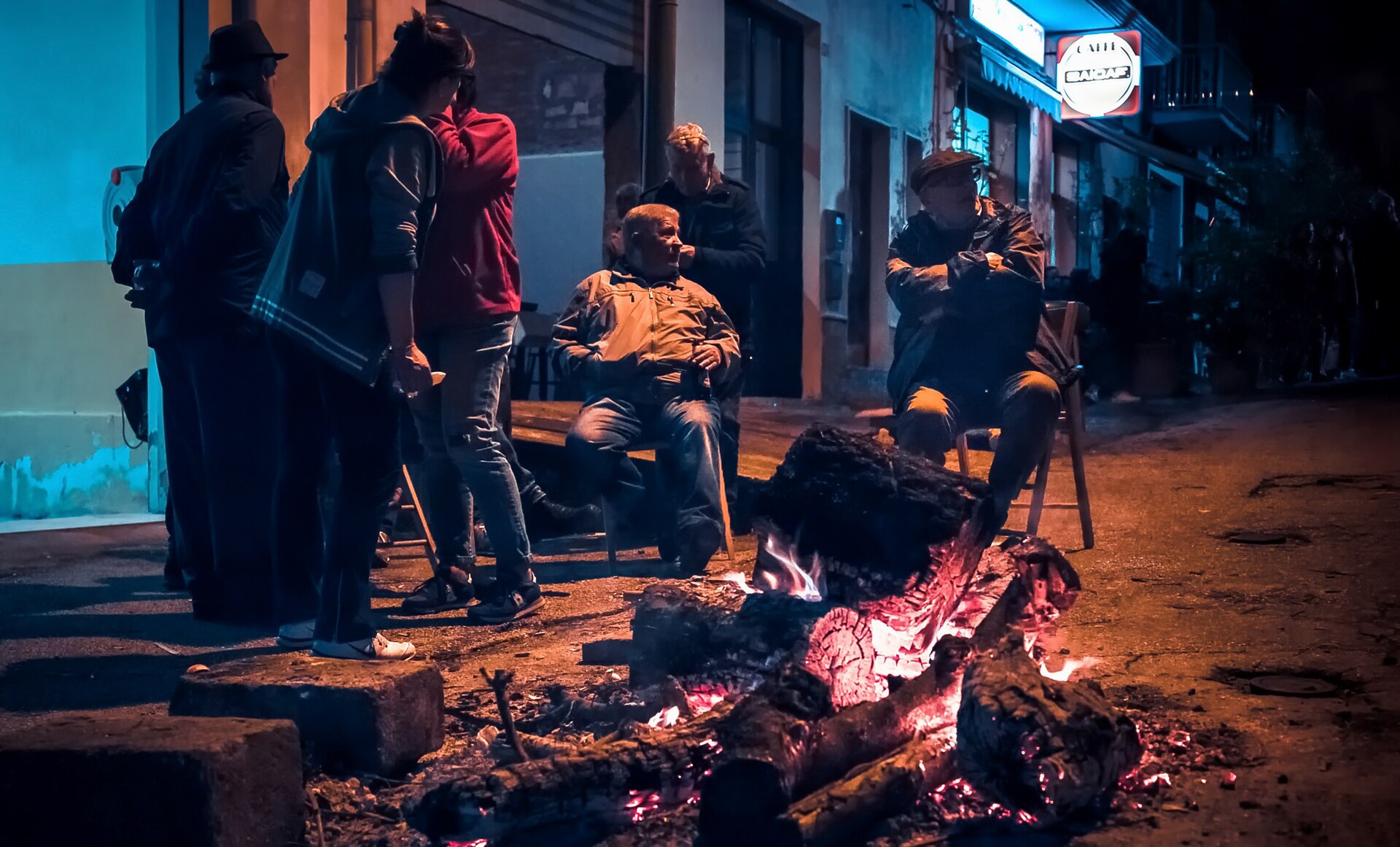
Orsara di Puglia (Foggia). On the night between 1 and 2 November the town celebrates Fucacoste e Cocce Priatorje, dialect for “bonfires and heads of Purgatory”. Fires of wood and broom are lit at crossroads and in squares, and pumpkins carved with human faces are displayed, lit by a candle. According to local tradition, that night the souls of the dead return to visit their homes before continuing their journey. The festival has become so famous that it draws tens of thousands of visitors to a town of about three thousand people.
Serra San Bruno (Calabria). Children used to go around with pumpkins carved like skulls, asking “Mi lu pagati lu coccalu?”, “Will you pay me for the skull?”. A request strikingly similar to “trick or treat”.
Veneto and Polesine. Here the hollowed, lit pumpkins were called suche dei morti or lumasse. In the Polesine area farmers would leave them in dark places, sometimes near cemeteries, to mimic the apparition of souls and frighten anyone passing by at night. Exactly what Irish youngsters did with their turnips.
Lombardy and Piedmont. In the Po Valley the tradition of lümere survives: carved pumpkins with a candle inside. In some villages near Varese, such as Buguggiate, the “Night of the Lümere” on 31 October has been revived with processions of lit pumpkins and bonfires. According to tradition, the lanterns showed the dead the way to the graveyard. In Bormio, in Valtellina, on the night of 2 November a pumpkin full of wine was placed on the windowsill to quench the thirst of the dead, while in several parts of Lombardy a jug of fresh water was left in the kitchen for the same reason.
Sardinia, Abruzzo, Emilia. In Sardinia children knocked on doors asking for sweets and dried fruit “for the souls”, is animeddas, and after dinner the table was left set. In Abruzzo people carved pumpkins and left in the window as many candles as there were departed loved ones. In Emilia-Romagna the poor went from house to house asking for the “carità di murt”, charity for the dead.
There is no need to force the connection: no direct thread ties Stingy Jack to the pumpkins of Orsara. But the fact that Irish, Venetian and Apulian peasants, without knowing each other, had the same idea (hollow out a vegetable, put a light inside and give it a face, on the night the dead return) says something profound about how human beings have always tried to look the dark in the face.
So, does Jack exist?
Historians broadly agree: Stingy Jack is a folklore character, probably born to give a face and a story to those unexplained lights in the bogs. His dealings with the Devil belong to a family of tales found all over Europe, that of “the smith who outwits the Devil”, catalogued by folktale scholars.
And yet, for generations, thousands of people in Ireland swore they had seen his lantern moving over the peat. Some turned their coats inside out to find their way. Some, like Patrick Dwyer, walked all night only to end up in front of their own gate.
Maybe it was just methane bubbles and microlightning. Maybe it was tiredness, darkness, one drink too many, just like the ones Jack loved so much. Or maybe, now and then, it was something else.
This Halloween, when you light the candle inside your pumpkin, remember you are repeating a gesture centuries old. And if outside the window you see a small light moving in the fog, maybe don’t follow it.
Sources
- National Museum of Ireland, Ghost turnip, Fintown, Co. Donegal (F1943.350)
- National Folklore Collection UCD, The Schools’ Collection, Clonfinlough, Co. Offaly, Mocollop, Co. Waterford, Tankerstown, Co. Tipperary, Lisheennaheltia, Co. Galway, Wexford (CC BY 4.0)
- Ronald Hutton, The Stations of the Sun: A History of the Ritual Year in Britain, Oxford University Press, 1996
- Nicholas Rogers, Halloween: From Pagan Ritual to Party Night, Oxford University Press, 2002
- Lisa Morton, Trick or Treat: A History of Halloween, Reaktion Books, 2012
- Online Etymology Dictionary, Jack-o’-lantern
- Wikipedia, Jack-o’-lantern
- Smithsonian Magazine, When People Carved Turnips Instead of Pumpkins for Halloween
- America Magazine / CNS, Irish folklife expert says Halloween traditions began in Ireland (2017)
- History.com, How Jack O’Lanterns Originated in Irish Myth
- ScienceAlert, Microlightning and will-o’-the-wisps
- Focus (IT), What “lights” will-o’-the-wisps
- Geopop (IT), Will-o’-the-wisps, from legend to microlightning
- Focus (IT), Italian Halloweens
- VareseNews (IT), Night of the Lümere (2016)
- La Voce di New York, L’Italia dei morti
- Un po’ di pepe, Fucacoste e cocce priatorje
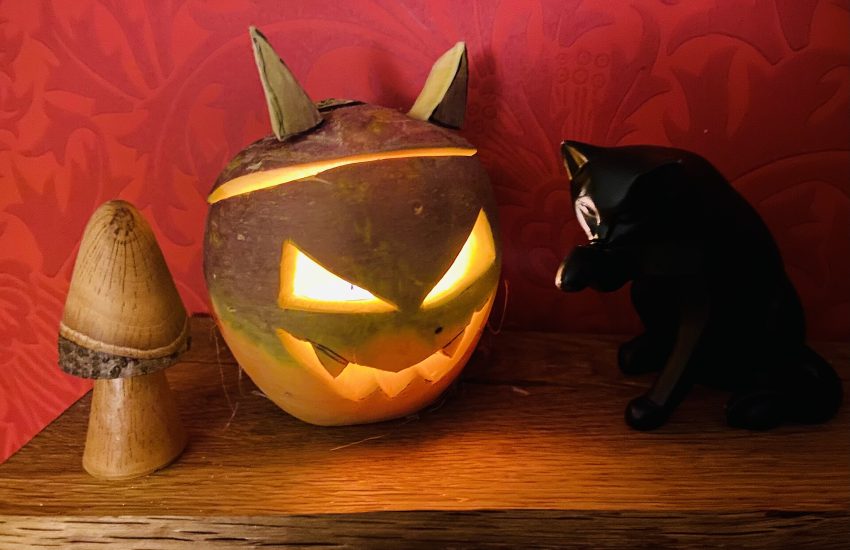
Featured image: Scottish turnip lantern, photo by LornaMCampbell, Wikimedia Commons, CC BY-SA 4.0.