 Posted by
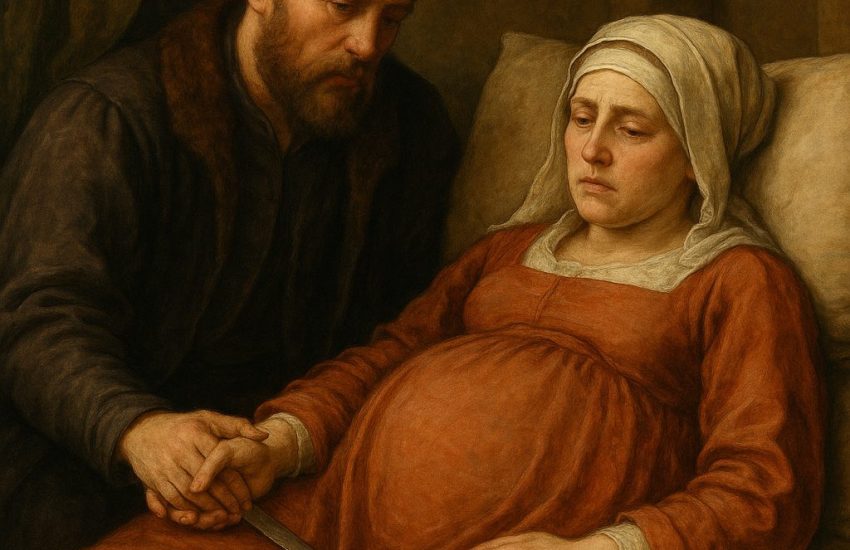
 In the heart of 16th-century Switzerland, when medicine was still dominated by superstition and uncertain attempts, an episode took place that would challenge the logic of the time. Jacob Nufer, a simple pig castrator, found himself facing a drama that no man would ever want to face: his wife, Elisabeth Alespachin, had been in labor for days, but the baby would not be born.
The thirteen midwives called to help her had tried every known remedy. Nothing worked. With every hour that passed, a fatal outcome became more likely, and in those days, a woman trapped in a stalled labor had no hope. To everyone, Elisabeth’s fate seemed sealed.
But Jacob did not give up. He was not a doctor, he had no training, yet he knew the practice of incisions on animals and knew how to use a knife. He asked the local authorities for permission, a detail that testifies to how extraordinary the decision was, and, armed only with his work tools, he performed the act that would change history: he opened his wife’s abdomen to extract the baby.
There was no anesthesia. There were no sterile conditions. There were not even any manuals explaining what to do. There was only a desperate man, ready to risk everything to save the one he loved.
And then something happened that no one could have predicted. Elisabeth survived. The newborn baby breathed. And, against all odds, life prevailed. But the miracle did not end there: in the following years, the woman gave birth to five more children, including twins, all by natural birth. A circumstance that still leaves scholars incredulous today.
However, news of this feat was not immediately passed on. Only eighty years later, in 1582, did the scholar Caspar Bauhin report the story in a medical work, including it in the Latin translation of a French obstetrics treatise. Since then, the story of Jacob Nufer has remained suspended between reality and legend.
Medical historians have long wondered: how is it possible that a woman who underwent a primitive caesarean section could not only survive, but also have other children without complications? Some think that there was a misinterpretation, others hypothesise an ectopic pregnancy. Finally, there are those who see the story as a narrative embellished over time.
Yet, beyond the doubts, the name of Jacob Nufer continues to be remembered. Because his story embodies the power of an extreme gesture: an ordinary man who, driven by love and desperation, chose to attempt the impossible. An act that anticipated, in a rudimentary and risky way, one of the most important and life-saving surgical practices of modern medicine.
Jacob was not a surgeon. He was not a doctor. He was just a husband who did not want to give up. And that is precisely the power of his story: it reminds us that, sometimes, a turning point in history comes from a desperate act performed by an ordinary person.