 Posted by
 The story of Alexander “Sawney” Bean is one of Scotland’s most macabre and gruesome legends, a tale that straddles the line between horror myth and alleged true crime, becoming a powerful narrative tool for Edinburgh tourism and inspiring numerous works of popular culture.
The origins of the monster, Sawney Bean the cannibal
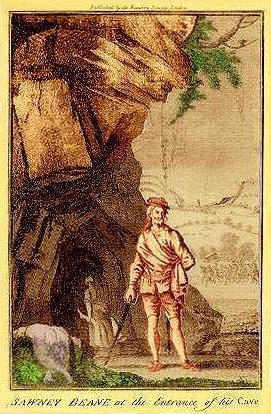
According to the Newgate Calendar, a register of criminals compiled in London’s Newgate Prison, Sawney Bean was born in East Lothian during the 16th century. The son of a ditch digger, he soon showed a strong aversion to honest work and ran away from home with a woman named Agnes Black, described as having similar criminal inclinations. The couple settled in a cave about 183 meters deep on the coast of Bannane Head in Galloway (now South Ayrshire), whose entrance was submerged at high tide, providing the perfect hiding place.
In this isolated place, the couple started a clan through incestuous relationships, which grew to 48 members in 25 years: 8 sons, 6 daughters, 18 grandsons, and 14 granddaughters. With no intention of working, the clan survived by ambushing isolated travelers or small groups at night. The victims were murdered, robbed, and their bodies taken to the cave to be dismembered and devoured. The inedible remains were scattered at sea, while parts of the bodies were preserved in brine.
Twenty-five years of unsolved murders
For a quarter of a century, neighboring communities had to deal with a mysterious string of disappearances and the discovery of human remains on local beaches. The authorities’ inability to provide convincing explanations created a climate of widespread suspicion that even led to the lynching of innocent citizens unjustly accused of the murders. The Beans, skilled at moving exclusively at night and keeping the location of their hideout secret, continued their cannibalistic activities undisturbed.
The fall of the clan
The end of the clan came when, during an ambush, they attacked a married couple returning from a fair. While they managed to kill the woman, the husband put up such fierce resistance that he managed to hold them off until other travelers arrived, forcing the Beans to flee. The man survived and reported the incident. The news reached King James I of Scotland, who personally led a manhunt with 400 soldiers and packs of dogs. The hounds sniffed out the entrance to the cave, revealing its gruesome contents: hanging human remains, pickled limbs, and piles of stolen goods. The entire clan was captured and taken in chains to Edinburgh Prison.
Without trial, an exemplary punishment was carried out: the men had their genitals, hands, and feet amputated and were left to bleed to death. The women and children, forced to watch, were then burned alive at the stake. A local legend from Girvan adds that a daughter of Sawney, who had strayed from the clan, was discovered and hanged by the angry mob from a tree known as the “Hairy Tree.”
Historical accuracy
There is no historical evidence, official documents, or trial records to confirm the existence of Sawney Bean or his crimes. The story first appeared in 18th-century English scandal pamphlets, leading many historians to consider it an urban legend or a form of anti-Scottish propaganda, spread after the Jacobite rebellions to portray the Scots as barbaric and primitive. The absence of contemporary sources and the logistical improbability that such a large clan could remain hidden for 25 years fuel skepticism.
Legacy in Popular Culture
Despite its dubious veracity, the legend of Sawney Bean has had a lasting impact:
- Cinema: It inspired horror films such as Wes Craven’s The Hills Have Eyes (1977) and Rob Schmidt’s Wrong Turn (2003).
- Literature: Writer Jack Ketchum based his novels Offspring and The Woman on it.
- Comics and Anime: It is mentioned in the series Attack on Titan and in the Italian comic Nick Raider.
- Video Games: The cannibal gang “Clan Murfree” in Red Dead Redemption 2 is clearly inspired by the Bean clan.
Sawney Bean remains a legendary figure, a product of Scottish macabre folklore and popular fiction, whose story continues to fascinate and terrify.
Main image: Sawney Beane and his wife outside their cave in Scotland. Engraving by Isacc Basire from J. Nicholls, circa 1734.