 Posted by
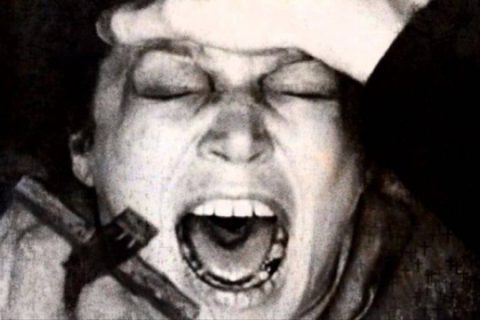
 Sudden convulsions, superhuman strength, blasphemous words shouted in languages never learned, and a fierce hatred for all that is sacred. For 16th-century medicine, there was no doubt: it was not illness, it was demonic possession. Thus began the story of Nicole Aubry, a 16-year-old French girl who, in 1565, became the center of one of the most spectacular and disturbing exorcisms in European history.
The story of Nicole Aubry
The 16th century in France was a turbulent period. Religious wars between Catholics and Protestants were tearing the country apart, and fear of the devil was palpable. Possessions were seen as tangible evidence of the presence of evil and, above all, as divine warnings in an age when faith and superstition were intertwined.
The symptoms of possession
Nicole Aubry lived in Laon, a town in Picardy. According to reports, one day she began to exhibit strange symptoms: uncontrollable convulsions, sudden screams, blasphemous phrases uttered in languages she had never studied.
One of the chroniclers of the time wrote: “The young girl was prey to dark forces that spoke with a voice not her own, and the whole city trembled at the sound of those words.”
One witness stated: “She spoke Latin and Greek, languages she had never learned, and laughed at the holy signs placed before her.”
Her body seemed to be moved by invisible forces, her voice changed beyond recognition. For the doctors of the time, there was no natural explanation: Nicole was a victim of the devil.
The public exorcism
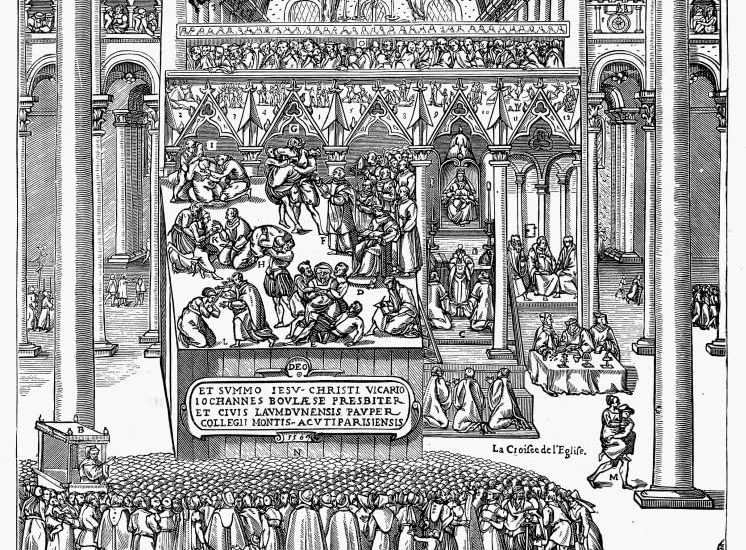
The archdiocese decided to intervene. But the exorcism was not an intimate and silent ritual: it turned into a public event, followed by crowds of curious onlookers and faithful. Hundreds of people gathered to witness the confrontation between the priests and the demon that was said to inhabit the young woman.
The chronicles report: “The devil, forced to speak, confessed that he had been sent by Satan himself to tempt the faith of the good Christians of Laon.”
The rituals lasted for days. Prayers, liturgical chants, invocations, and crosses raised in front of Nicole’s face alternated with inhuman screams and body contortions. The entire city became the stage for a sacred drama, where the boundary between faith and fear dissolved before everyone’s eyes.
The liberation
After days of incessant rituals, Nicole Aubry was finally declared liberated. The convulsions ceased, her voice returned to normal, and her body calmed down. For the crowd, and for the Church, it was a victory of faith over evil.
A priest noted: “The enemy was driven out by the power of the Cross, and the girl returned pure in the eyes of God.”
Yet, behind this liberation, questions remain. Was it really possession? Or rather a disorder that the medicine of the time could not understand?
A forgotten case
The case of Nicole Aubry is little known today, overshadowed by more recent and famous events, such as that of Anneliese Michel in Germany. Yet, in the 16th century, it caused a sensation and remained engraved in memory as one of the first great exorcisms documented in Europe.
A story that transformed a 16-year-old girl into the unwitting protagonist of one of the most spectacular struggles between the Church and the devil.
It reminds us how thin the line between faith, superstition, and illness was in centuries past.
Behind every story of possession, in fact, there always remains a shadow of doubt.
Historical sources
- Jean Boulaese, Histoire prodigieuse et mémorable de la possession et delivrance de Nicole Obry de Laon (Paris, 1566).
- Acta Ecclesiae Laonensis, 16th century.
- Augustin Calmet, Traité sur les apparitions des esprits et sur les vampires (1751).
- Jacques Collin de Plancy, Dictionnaire Infernal (1818-1863).