
 Posted by
Strasbourg, mid-July 1518. On one of the city’s narrow lanes, between timber-framed houses and workshops, a woman starts to dance. There is no festival. No piper, no drum, nobody keeping time. She just dances, with movements that don’t look like her own. Hours go by and she doesn’t stop. The next day she is still at it.
Within days, others join her: craftsmen, servants, women, travellers. Within a week there are dozens. The city’s physicians are baffled. The council meets. The bishop writes asking what on earth is going on. This is the start of one of the strangest episodes in European history: the dancing plague of 1518, the best documented of all medieval “dancing manias”.
But what do we actually know? Less than most retellings suggest, and in some ways a lot more. There is a big gap between the archive papers written in 1518 and the chronicles written decades later. And in that gap, the story grew: the number of dancers, the death toll, even the name of the woman who started it.
What: an outbreak of involuntary dancing, known at the time as St Vitus’s sickness or St Vitus’s dance.
Where: Strasbourg, then a free city of the Holy Roman Empire (today Alsace, France).
When: mid-July to late summer 1518.
How many: about 50 according to documents from 1518; “more than 100 at once” according to Daniel Specklin; up to 400 in a later family chronicle.
Deaths: no contemporary source mentions any. Claims of up to 15 a day only appear in later texts.
How it ended: the dancers were taken on pilgrimage to the shrine of St Vitus above Saverne.
Theories: mass psychogenic illness, ergot poisoning, a religious practice tied to the cult of St Vitus. None is proven.
Strasbourg in 1518: rich, proud and on edge
In the early 1500s Strasbourg was one of the great cities of the Rhine. As a free imperial city, it answered directly to the emperor and ran its own affairs through a council known as the Magistrat. Its cathedral spire was among the tallest in Europe. Printers, humanists and merchants filled its streets. The city secretary was a European celebrity: Sebastian Brant, author of the bestselling satire The Ship of Fools (1494).
Life below the surface was harder. Historian John Waller, whose book A Time to Dance, a Time to Die (2008) is the best-known account of the outbreak, describes years of poor harvests, expensive bread, political unrest and new diseases such as syphilis. Religious tension was rising too. Only months earlier, in October 1517, Martin Luther had gone public with his attack on indulgences.
Not every historian accepts this bleak picture. Alsatian medievalist Élisabeth Clementz, reviewing the French edition of Waller’s book, rejected several of its “clichés”, including the idea that leprosy, smallpox and plague were all making a comeback in Alsace in 1518. That, she argued, would be hard to prove.
The woman who started it
The popular version comes with a date, 14 July 1518, and a name: Frau Troffea. She is said to have danced alone outside her house for four to six days while her husband begged her to stop, until she was carted away exhausted.
This is where the sources part ways. The three accounts written in 1518 or shortly after (Sebastian Brant’s Annals, the chronicle of humanist Hieronymus Gebwiler and the council’s reply to the bishop) all describe an unnamed woman, copied by around fifty people. The name Troffea comes from Paracelsus, the Swiss physician, who only settled in Strasbourg in late 1526. He wrote about a “Frau Troffea” who faked the illness whenever her husband annoyed her, but never said where or when she lived. Clementz calls the name “highly improbable”, and the catalogue of the 2018 Strasbourg exhibition calls it an invention, along with another name that sometimes circulates, “Ennelin”.
So there really was a first dancer, and she was a woman. Her name, her street and her personal story are lost.
From fifty to four hundred: how the numbers grew
How many people danced? It depends on what you read, and above all on when it was written.
- About 50: the figure in contemporary documents. One source already gives it for 25 July.
- 34 in a week: Waller’s figure for the first days, drawn from the chronicles.
- “More than 100 at once”: according to architect and engineer Daniel Specklin, whose Collectanea were presented to the council in 1587, almost seventy years later.
- About 400: according to the chronicle of the Imlin family, also written later.
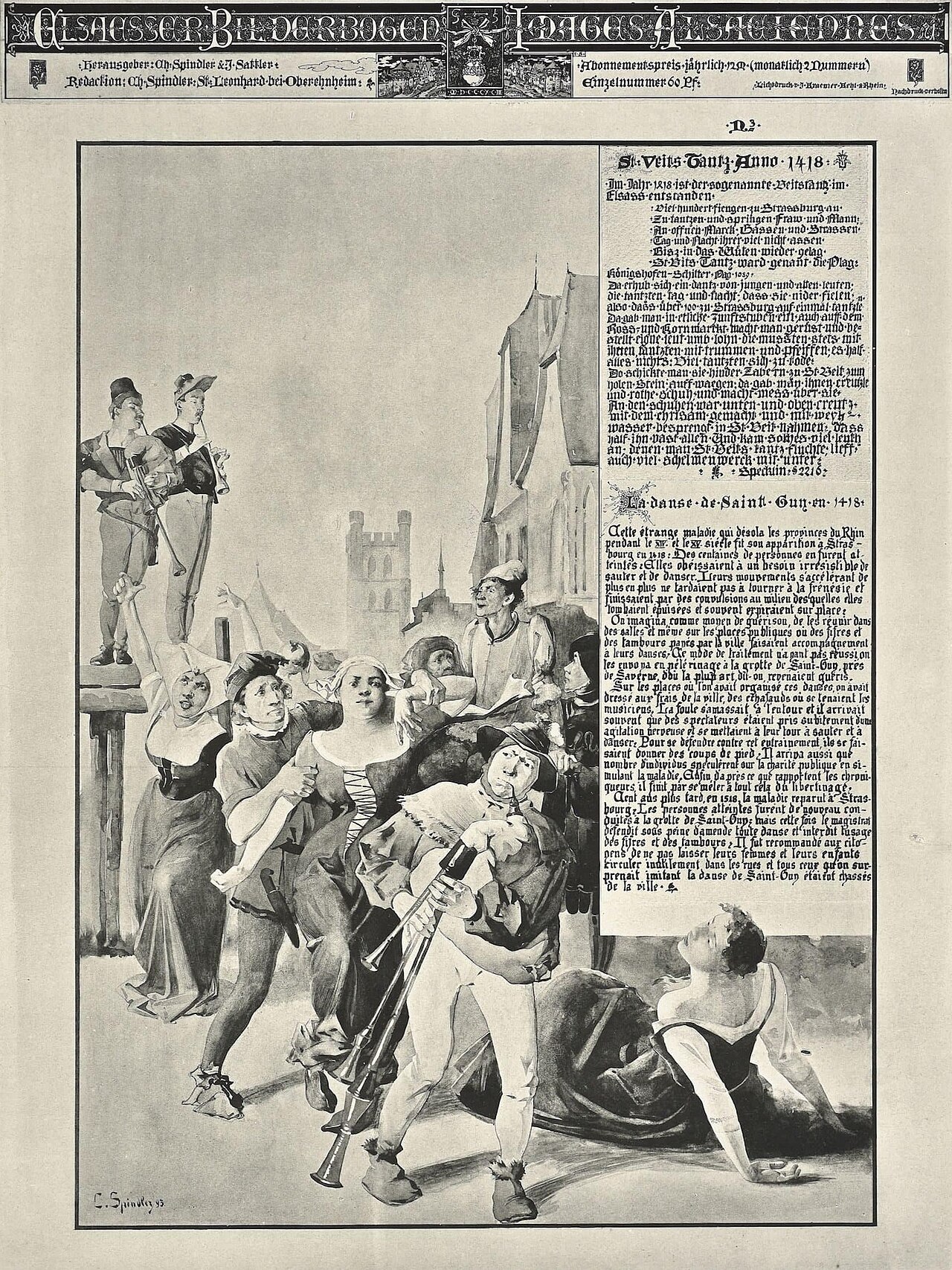
The trouble with the late sources is obvious. Specklin’s chronicle, for one, had a rough journey: the original manuscript was lost in the nineteenth century, and what we read today is a reconstruction published by Rodolphe Reuss in 1890. Other chronicles date from the 1600s. And in the nineteenth century, German physician J. F. C. Hecker, who made medieval “dancing mania” famous, dated the Strasbourg outbreak to 1418, a full century too early. That mix-up still turns up in some books.
Did people really dance to death?
This is the detail that made the story famous: people dancing “until they died”, with up to 15 deaths a day at the peak. Almost every article online repeats it.
Yet according to Clementz, no contemporary writer mentions a single death. The deaths appear in Specklin, who wrote that “many danced themselves to death”, and in even later chronicles such as that of Johannes Wencker, born in 1590, more than seventy years after the events. Waller argues that Wencker drew on the memories of dozens of survivors. Clementz finds that hard to believe, given the dates. English Wikipedia now notes that historians disagree on whether anyone died at all, and German news portal web.de, drawing on Frankfurt historian Gregor Rohmann, files the death stories under “myths”.
That doesn’t mean nobody died. Dancing for days in July heat, with little food, can kill. It means the horrifying “15 a day” has no solid footing in the documents of 1518. How many died, if any, remains unknown.
What the archives actually say
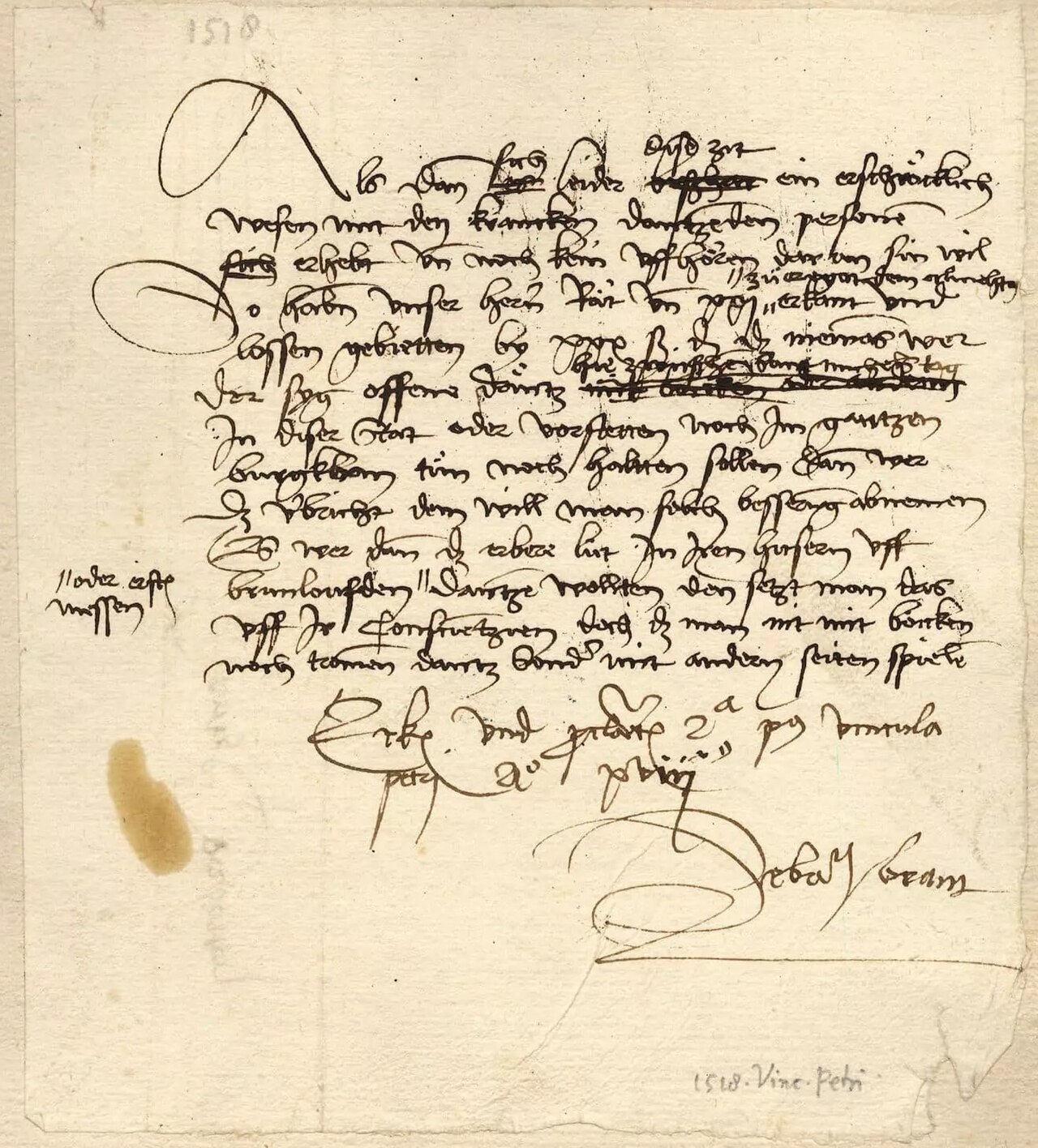
Fortunately, Strasbourg still holds papers written while the outbreak was under way. They were shown in 2018 at the Musée de l’Œuvre Notre-Dame, in the exhibition 1518. La fièvre de la danse (“1518: Dance Fever”), curated by Cécile Dupeux with historians Georges Bischoff and Élisabeth Clementz. In order:
- 23 July 1518: deliberations of a committee appointed by the council, plus instructions about the people to be sent to Saverne (Strasbourg municipal archives, series III, 200/15). There is also a note from the council to the city’s confraternities.
- 25 July 1518: a letter from the council to the Bishop of Strasbourg, Wilhelm von Honstein, who had asked about this “unusual sickness” (der ungewönlichen kranckheit halb). It is held today in the Bas-Rhin departmental archives (12 J 1495).
- 2 August 1518: the ban on public dancing, on a sheet signed by Sebastian Brant.
The dates tell an interesting story. In the popular version, the pilgrimage to St Vitus is a last resort after weeks of failed remedies. The archives, however, mention people being sent to Saverne as early as 23 July, barely ten days in. The two approaches probably ran side by side all summer.
“Dance it out”: the cure that made things worse
According to the letter to the bishop, the physicians saw the illness as “natural”, caused by that year’s alignment of the stars and by the summer heat. Later accounts talk mainly of “overheated blood”, in line with Galen’s theory of the humours. Either way, the doctors ruled out supernatural causes. Instead of bleeding the patients, they reportedly prescribed something odd: let them dance until the fever burned itself out.
The chronicles say the authorities opened up the guildhalls of the carpenters and the tanners, cleared the grain market and built a wooden stage across from the horse market. They paid musicians with drums, fifes and pipes, and hired strong men and women to dance with the sick and hold them up. Specklin adds that food and wine were handed out, and that beggars, prostitutes and other “indecent” people were thrown out of the city.
It backfired. The music drew crowds, the spectacle fed the fear and, according to Waller, many became convinced that St Vitus himself was punishing the city. So the council changed course. The stages came down and nearly all dancing and music was banned. “Respectable” people could still dance at weddings and first Masses, but only to stringed instruments, with no drums or tambourines. Specklin says the ban was only lifted at the end of September.
A detail few accounts mention: dancing stayed under suspicion. The Strasbourg archives hold another dancing ban dated 15 June 1547, which happens to be the feast day of St Vitus.
The pilgrimage to the cave of St Vitus
In early August, Specklin writes, craftsmen were sent to Saverne (German: Zabern), about 40 kilometres northwest of Strasbourg, to get the chapel of St Vitus ready. The sick were gathered from the streets, loaded onto wagons and sent off with minders.
Their destination was the shrine of the Hohlenstein in the wooded hills above Saverne: a large sandstone cave, first recorded in 1338, with a chapel built in the late 1400s or early 1500s. The ritual there was precise. Priests gave each dancer a pair of red shoes, sprinkled them with holy water on top and underneath, and marked them with crosses of consecrated oil. The sick held small crosses amid incense and Latin prayers. They were led around the altar, made a small offering (paid by the city for those who couldn’t afford it) and heard Mass. According to Specklin, the pilgrimage helped almost all of them.
Why red shoes? Nobody knows for sure. One suggestion points to the legend of St Vitus, a martyr said to have been thrown into a cauldron of boiling oil. Saverne’s parish church still has a 17th-century statuette showing him rising from the pot.
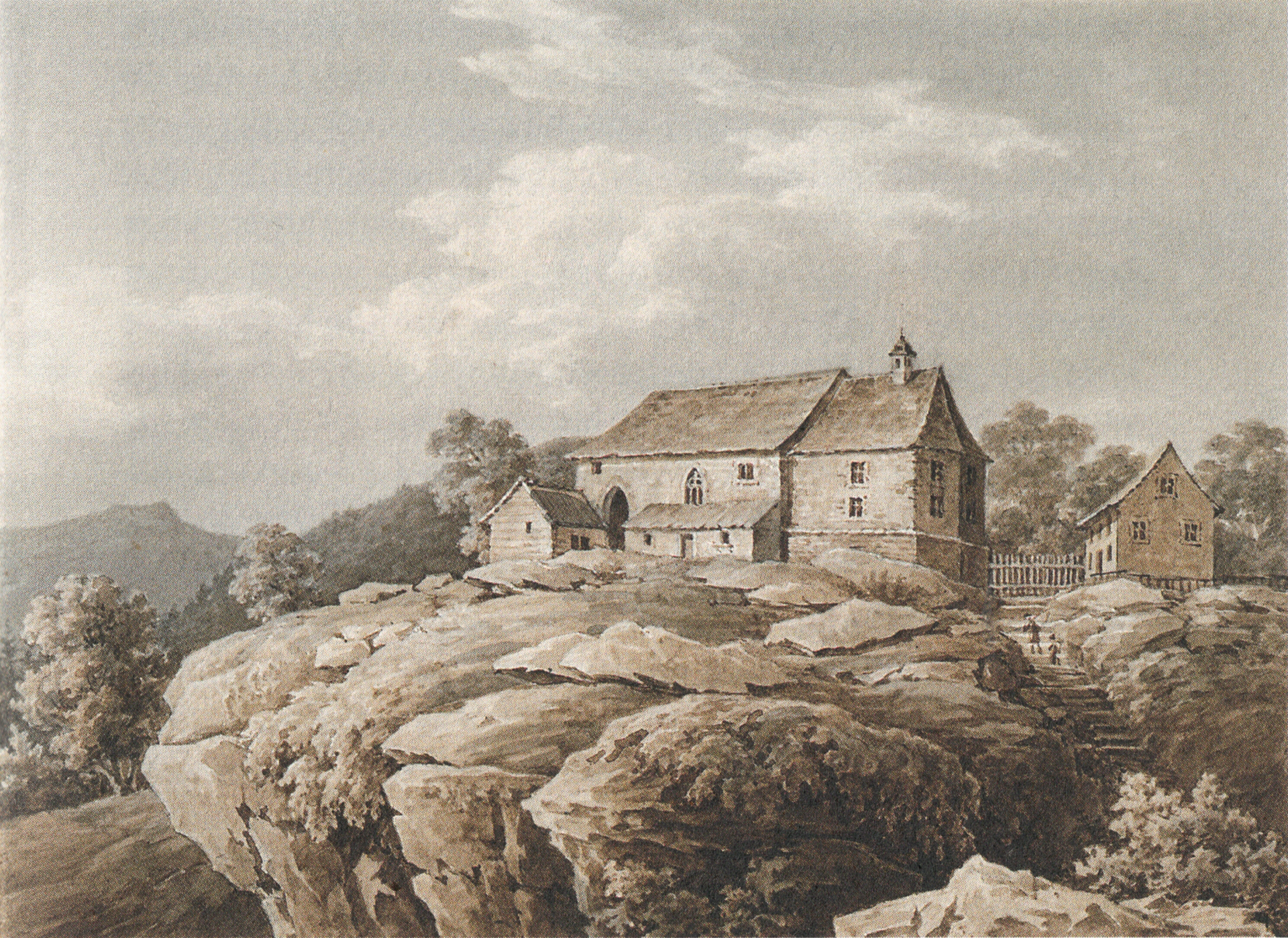
The shrine has had an eventful history. A hermit’s house is recorded there from 1520. During the French Revolution, in 1793, the site became a farm. In 1818 the cult of St Vitus moved into the chapel inside the cave, and in 1865 a fire destroyed the buildings. Today the Grotte Saint-Vit is reached by a forest trail near the ruins of Greifenstein castle. It is open, unlit and free. Little remains of the upper chapel. The Château des Rohan museum in Saverne keeps a painted wooden relief of the Virgin, St Vitus and a pope linked to the cult.
Why St Vitus?
In the late Middle Ages St Vitus (French saint Guy, German Sankt Veit) was invoked against epilepsy, convulsions and other ailments that made the body move on its own. People believed he could send the dance as a punishment, and also cure it. That’s where “St Vitus’s dance” comes from. Doctors later borrowed the phrase for real neurological conditions such as Sydenham’s chorea, but that’s a different thing: an infection that causes involuntary jerks, not days of rhythmic dancing. The other saint tied to dancing was John the Baptist, whose feast falls on 24 June. In 1374 people spoke of “St John’s dance”.
The Reformation weighed in too. In a conversation in 1533, Philip Melanchthon dismissed St Vitus’s dance as pure “obsession by the Devil”, and Luther replied that the phantom was already fading.
Not the first time: dancing outbreaks along the Rhine
Strasbourg 1518 is the most famous case, but not the first. Waller points out that every major European dancing epidemic between 1374 and 1518 happened in a fairly compact area along the Rhine and the Moselle:
- Kölbigk, Saxony (11th century): the legend of revellers who danced in a churchyard on Christmas Eve, were cursed by the priest and couldn’t stop for a year.
- 1374, Aachen and the Low Countries: men, women and children danced for hours in the streets. Chronicler Peter of Herentals wrote that they danced “in their homes, in the churches and in the streets”. It spread to Liège, Utrecht and Tongeren.
- 1463, Obernai (Alsace): the town accounts record a payment to “sick dancing people” who had come from Saint-Jean-de-Bassel, some 80 kilometres away.
- 1518, Basel: according to Gregor Rohmann, there were isolated cases there while Strasbourg danced.
Meanwhile, southern Italy had tarantism: people in Apulia who said a tarantula had bitten them and were “cured” by dancing to the right music. And Flanders had its pilgrimages to Molenbeek near Brussels, drawn by Pieter Bruegel the Elder in 1564.
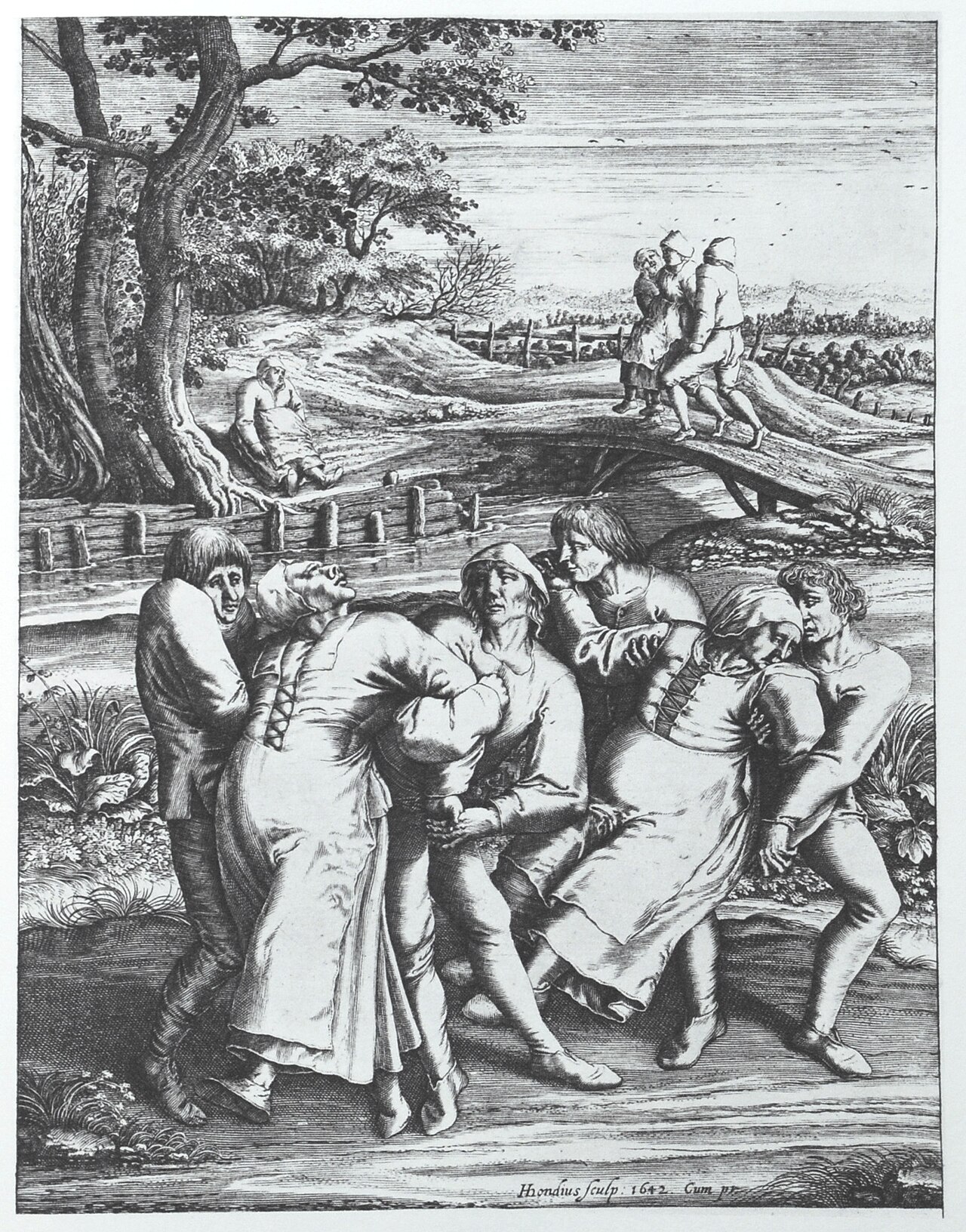
Paracelsus and his three kinds of dance
The first person to write a medical theory of St Vitus’s dance was Paracelsus himself, around 1537. He described three forms: chorea lasciva, driven by lustful desire; chorea imaginativa, produced by the imagination; and chorea naturalis, with physical causes. Today his tale of a wife who dances to spite her husband reads as plainly misogynistic. Still, he deserves some credit for looking for the cause in the mind rather than in demons or the stars.
Modern theories
Ergot poisoning
This is the theory you’ll see most often online. Ergot is a fungus, Claviceps purpurea, that grows on rye in damp years and produces compounds related to LSD. It can cause convulsions, spasms and hallucinations. But it also constricts blood vessels, cutting blood flow to the hands and feet, sometimes to the point of gangrene. Waller finds it hard to imagine poisoned people dancing in a coordinated way for days. Sociologist Robert Bartholomew adds that not all affected areas ate rye, and outbreaks didn’t always strike in wet seasons.
Mass psychogenic illness
This is Waller’s theory and today the most widely accepted. A population worn down by hunger and disease, and deeply afraid of St Vitus’s wrath, slips into an altered state of consciousness, a kind of trance. The trance spreads by suggestion: the more people dance, the more people fear they’ve been struck. Waller compares it to the laughter epidemic of 1962 at a school in Kashasha, in what was then Tanganyika (now Tanzania). According to Italian magazine Focus, it affected 95 of the school’s 159 pupils and forced the school to close. It’s the same family of phenomena we explored in The Devils of Loudun.
A religious practice, not a “mania”
A third, more recent school rejects the idea of collective madness. Bartholomew suggests many medieval “dancers” were pilgrims, whose rituals simply looked strange to outsiders. German historian Gregor Rohmann, author of a major study called Tanzwut (Göttingen, 2013), notes that the word itself is a 19th-century label stuck onto quite different events. In his view no modern syndrome explains them all. In Christian culture, involuntary dance was a sign of feeling abandoned by God and hoping for his return. And he adds, with rare candour: “We still don’t know what actually happened.”
What people thought at the time
For Strasbourg’s physicians, as we’ve seen, it was a natural illness caused by the stars and the heat. For the clergy, it was the anger of St Vitus. For the humanist Hieronymus Gebwiler, writing a few years later, it was a sign from God that the city should learn moderation, something to be remembered “for a thousand years”. Neurological explanations such as Huntington’s disease don’t hold up for something that struck dozens of people at once.
Five hundred years later
The Strasbourg dance has never lost its grip. French writer Jean Teulé turned it into the novel Entrez dans la danse (2018), later a graphic novel with Richard Guérineau. Director Jonathan Glazer shot the short film Strasbourg 1518 during the 2020 lockdown. Florence + the Machine wrote “Choreomania” (2022), and Kiran Millwood Hargrave built her novel The Dance Tree around it. Waller’s book, meanwhile, divides opinion. Clementz, who listed a series of errors in it, called it closer to a historical novel than a work of scholarship.
The dance of 1518 sits on the border between medicine and faith, like other strange cases we’ve covered, such as Gloria Ramirez, the “toxic lady”.
A city that danced without music
What’s left of that summer is a few archive sheets, a cave in the woods above Saverne and a story every century has told its own way. The documents speak of about fifty people, puzzled doctors and a council that first hired musicians and then banned drums. Later chronicles add hundreds of dancers and dozens of deaths. Maybe the truth lies somewhere in between. Maybe we’ll never know.
What remains is the image where it all began: a woman alone in a Strasbourg street, dancing to no music and unable to stop. Nobody ever found out for sure what she was feeling. Perhaps that’s exactly why, five centuries on, the story still unsettles us.
If you’re drawn to cases where mind, body and faith collide, read also The Devils of Loudun and Gloria Ramirez, the toxic lady.
Sources
- Élisabeth Clementz, review of J. Waller, “Les danseurs fous de Strasbourg”, Revue d’Alsace 142 (2016) (French)
- Musées de Strasbourg, press kit for the exhibition “1518. La fièvre de la danse” (2018) (French)
- Musées de Strasbourg, catalogue “1518. La fièvre de la danse” (French)
- Ned Pennant-Rea, “The Dancing Plague of 1518”, The Public Domain Review
- John Waller, “In a spin: the mysterious dancing epidemic of 1518”, Endeavour 32 (2008), via Medievalists.net
- Wikipedia, “Dancing plague of 1518”
- Wikipedia, “Épidémie dansante de 1518” (French)
- Wikipedia, “Straßburger Tanzwut” (German)
- Geschichte im Puls, “Bis zum Umfallen” (on Specklin and the council’s measures) (German)
- web.de, on historian Gregor Rohmann’s research (German)
- Gregor Rohmann, study of dance pilgrimages on the Upper Rhine (Badische Landesbibliothek) (German)
- French Ministry of Culture, Mérimée record for the Saint-Vit chapel, Saverne (French)
- Showcaves.com, Grotte de Saint-Vit
- J. F. C. Hecker, “The Dancing Mania” (1888 English translation)
- JSTOR Daily, “When Dancing Plagues Struck Medieval Europe”
- Smithsonian Magazine, on the 1374 Aachen outbreak
- HistoryNet, “The Dancing Plague of 1518”
- Focus, “La piaga del ballo del 1518” (Italian)
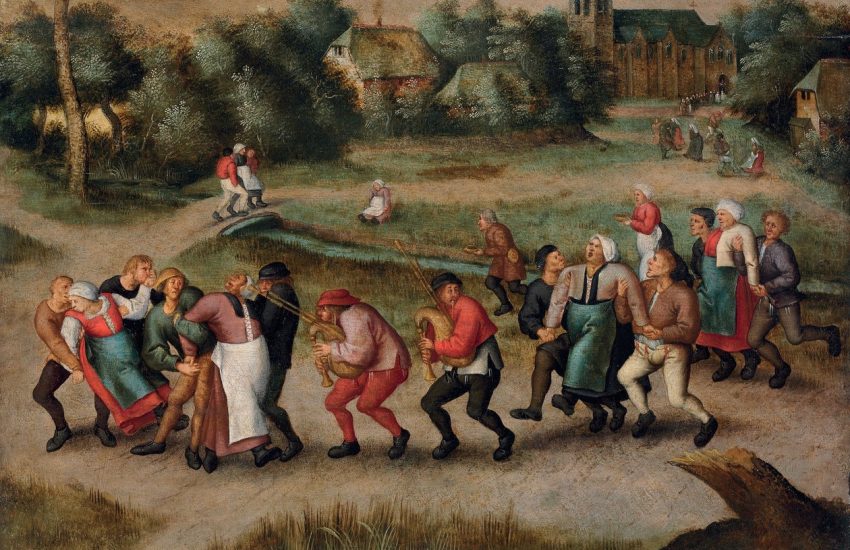
Featured image: Pieter Brueghel the Younger, Saint John’s Dancers in Molenbeek (1592), Wikimedia Commons, public domain.


